TerraLex Cross-Border Guide to Cross-Border Copyright Guide

We are delighted to present the TerraLex cross-border copyright guide 2019

Copyright rules across national boundaries are becoming increasingly relevant to businesses, particularly as the digital market makes its impact felt on all industry sectors. Issues such as digital content portability, pirated content and copyright licensing models now appear high on legislative agendas around the world and businesses need to be nimble enough to operate in an environment in which the creative industries operate globally, but copyright law still varies by jurisdiction.

This Guide draws together contributions from copyright experts in territories we have found are key to global businesses. We hope you will find the Guide a useful resource for getting to grips with the framework of copyright law in each of those territories, safe in the knowledge that if further specialist advice is needed, it’s only a call or email away.

We hope you find it a helpful resource – and do get in touch with any national or international copyright issues that you think we may be able to assist with.

How to Use: You can use the tools below to create bespoke reports for the jurisdiction(s) and topic(s) covered. Click into single jurisdiction for one location or use the compare tool to compare multiple jurisdictions. Select the jurisdictions and topics of interest to create your unique report. You also have the option to print or download using the ellipsis button in the top right corner.

China Cross-Border Copyright Guide Guide

Date posted:
22/04/2026
Last update:
09/10/2022

Legislation and regulations

What are the main sources of copyright law?

The main source of copyright legislation in China is the Copyright Law. The first Copyright Law was promulgated in 1990 by the Standing Committee of the National People’s Congress, which is the legislative body of the Chinese Government. This law has since been revised twice, in 2001 and 2010. A third revision is currently in discussion before the Legislative Affairs Office of the State Council. Judicial interpretations are another important source of copyright in China.

Judicial interpretations are another important source of copyright law in China. Judicial interpretations are binding opinions issued by the Supreme People’s Court on the implementation of certain laws. Regional courts can also issue interpretations, which would only be binding upon courts in those local jurisdictions. Chinese courts may cite judicial interpretations of the Copyright Law to support their reasoning in judgments.

As China is a civil law system, court decisions are not sources of copyright law and have no binding effect. However, certain guiding cases, which are selected and published by the Supreme People’s Court each year, have reference value to the lower courts. With the continued promotion of the case guidance system, recent years have seen a steady increase in the case citation rate in intellectual property cases.

Subsistence of copyright

What type of subject matter can be protected by copyright?

The types of work covered by copyright are: literary, oral, musical, dramatic, Quyi (see below for definition), choreographic, acrobatic, fine art, architectural, photographic, cinematographic (and those created by means similar to cinematography), graphic, model, and computer software. These are the broad categories of copyrightable works. Brief summaries of each category are below:

Literary works

These works include novels, poems, prose, treatises and other works that are expressed in written form.

Oral works

Oral works are impromptu speeches, lectures, court debates and other works that are expressed orally.

Musical works

Musical works include songs, symphonies and other similar works, with or without lyrics, that can be sung or played.

Dramatic works

Dramatic works include dramas, operas and other works that are created for stage performance.

Quyi works

Quyi works are works typically performed through conversation and singing, such as xiangsheng (comic dialogues), kuaishu (quick-patter), dagu (Chinese base drum), pingshu (storytelling based on classic novels like Romance of the Three Kingdoms), etc.

Choreographic works

Choreographic works are works that express thoughts and feelings through movements, dance, facial expressions, etc.

Acrobatic works

Acrobatic works include acrobatics, magic acts, circus acts and other performances that are expressed through bodily movements and techniques.

Fine art works

Works of fine art include paintings, calligraphy, sculptures and other two- or three-dimensional works or artistic creations formed by visual lines, colours and/or other patterns.

Architectural works

Architectural works include buildings or structural works.

Photographic works

Photographic works are art created by recording images of objects on light-sensitive materials or other media with the aid of instruments.

Cinematographic works and works created by means similar to cinematography

These are works captured on certain media and may include images with or without accompanying sounds, and disseminated with the aid of certain devices.

Graphic works

Graphic works include engineering design drawings and product design drawings created for construction or production, as well as maps and schematic drawings created to show geographical phenomena or demonstrate principles or structures.

Model works

These are three-dimensional works made to a certain scale according to the shape and structure of objects for display, testing or exhibition, etc.

Computer software

This covers computer programs and their relevant documentation.

Computer programs are sequences of command codes, symbolic command sequences or symbolic statement sequences, which can be automatically converted to a coded command sequence. These are executable by a computer or any other device with information processing abilities.

Documentation is written information and diagrams that are used to describe the content, composition, design, functionality specifications, development details, test results and usage method of a program, such as the program design description, flow chart and user’s manual.


What is required for works to qualify for copyright protection?

To be eligible for copyright protection, works need to be original intellectual creations of a type listed above. The works must also be capable of being reproduced in a tangible medium. A work is original if the author (see 3.1 for discussion on authorship) created the work through his/her own skill, judgement and individual effort and did not copy from other works. Works do not need to be of high artistic merit but must exhibit some modicum of creativity.

The work also does not need to be entirely original. Generally, the threshold for originality is low in China compared to other civil law countries such as France, Germany or Japan. As a general rule, Chinese law only accords copyright protection to works if the author is a Chinese national or if the work was first published in China or another country party to one of the various international conventions that China is also a party to.

What rights does copyright grant to rights holder?

The Copyright Law enumerates the rights that comprise copyright. These rights are the exclusive rights of the rights holder (before any licences are granted) and include the rights to:

  • reproduction, ie make one or more copies of a work by means of printing, photocopying, duplication, etc
  • distribution, ie make original or copies of works available to the public by sale or donation
  • rent, ie authorise others to use works on a temporary basis
  • exhibition/public display, ie showcase the original or copies of works
  • public performance/broadcast, ie perform the works or broadcast them via any medium
  • public exhibition via film projectors or other equipment of works of fine art, photographic works, cinematographic works, or works created by means similar to cinematography
  • public broadcast or dissemination of a work through wireless transmission, to disseminate a broadcast work to the public through wire transmission or rebroadcast, and to disseminate a broadcast work to the public through a loudspeaker or any other similar instrument used to transmit symbols, sounds or images
  • dissemination of a work via an information network, ie make a work available to the public by wired or wireless means
  • fixation of a work in a medium by cinematographic or similar means
  • creation of derivative or adapted works so as to create a new work
  • translation
  • compilations or arrangements
  • other rights to which a copyright owner will be entitled.

Are moral rights protected (for example, rights to be identified as an author of a work or to object to derogatory treatment of a work)?

Yes. In China, the Copyright Law provides the following moral rights for all types of works:

  • the right to publish a work
  • the right to be credited as the author of a work
  • the right to alter or authorise others to alter a work
  • the right to object to derogatory treatment of a work.

What is the duration of copyright in protected works and other subject matter?

Copyright term varies by right. For example, an author’s moral rights to attribution, to alter (or authorise others to alter) the work, and to object to derogatory treatment of his or her work are perpetual.

However, the term for the moral right to publish a work and any economic copyrights (see 2.3) is the life of the author plus 50 years. The term of protection ends on 31 December of the 50th year after the author’s death. For jointly‑created works, the term runs from the work’s creation to 31 December of the 50th year after the death of the last known author.

The right of publication and other economic rights for works created by a legal person or an organisation, or works made for hire, have terms of 50 years beginning from the date of creation. The term ends on 31 December of the 50th year after creation.

The copyright term for cinematographic works, works created by means similar to cinematography, or photographic works is different from the term for other types of works. The term for the publication right and economic rights (see 2.3) for these works is 50 years starting from the date of publication. The term ends on 31 December of the 50th year after the first publication date. If the work is never published, its term of protection is 50 years from the date of creation.

Orphan works, which are works whose author cannot be identified or contacted, are protected for terms of 50 years, which begin on the date of the first publication.

For how long do moral rights subsist in copyright works?

See 2.5. An author’s moral rights to attribution, to alter (or authorise others to alter) the work, and to object to derogatory treatment of his or her work are perpetual. Similarly, a performer’s moral rights to be identified as the performer and to protect his/her performance from distortion are perpetual. The right to publish a work persists for the life of the author plus 50 years, if the author is an individual. For cinematographic works, the term is 50 years after the work’s first publication, depending on the type of cinematographic work. Works authored by legal persons have terms of 50 years from the date of creation.

Ownership

Who is the first owner of a copyright work?

As a general rule, the initial owner of the copyright to a work is its author. Under the Copyright Law, an author can be an individual or a legal person (such as a corporation). Normally, an individual who creates a work is its author. Works created with the sponsorship of, or according to the intent of, another legal person or organisation responsible for such works are considered authored by such legal person or organisation.

The main exception to this rule involves works for hire where the work is graphical in nature or is computer software. Where an employee creates such a work using the employer’s resources, materials or technical support, the copyright will vest in the employer irrespective of if the work was created under the direction of or for the employer or not. In other words, as long as an employee utilises employer resources to create a graphical work or computer software, the copyright will automatically vest in the employer even if the employee created such work outside the direction of the employer.

The copyright for works made for hire may also vest in employers pursuant to laws, regulations and contracts. However, the author always reserves the right of authorship. Another exception is where a contract for the creation of a work explicitly states that the copyright in a commissioned work belongs to the commissioning party. Here, the commissioning party may acquire the copyright in the work and become the first owner.

The Copyright Law also provides specific rules on the ownership of cinematographic works. Specifically, the copyright in such works will generally vest in the producer, provided that the screenwriter, director, cinematographer, lyricist, composer and other authors reserve their authorship rights in any work they contributed.

Can copyright in a work be jointly owned? If so, what are the rights of a co-owner?

Yes. Copyright in a work can be jointly owned by two or more persons. This can occur where a work is created by more than one person or where the copyright in a work is assigned either in part or in whole.

To qualify as joint authors, each author must share a joint intent of creation. In other words, both/all authors must be aware that they are collaborating together to create something and intend to combine their work into a single creation.

Joint owners will negotiate in good faith on how to exploit the work. If no consensus can be reached through friendly consultation, each owner may use the work or license the work, provided that the royalties are shared among the joint owners. Assignment of the copyright requires the consent of all joint owners.

Can you register copyright? If so, what are the benefits of such registration and what other steps, if any, can you take to help you bring an infringement action?

Yes. Copyrights can be registered in China even though the copyright attaches automatically upon creation. Copyright registration is prima facie evidence of ownership of a copyright. In a copyright infringement action, the rights holder may use a copyright registration to certify his/her rights, provided that there is no evidence to the contrary.

A copyright notice may be useful evidence of copyright ownership and of the date of authorship. According to the Copyright Law, in the absence of evidence to the contrary, the author of a work will be the individual, legal person or other organisation whose name is affixed to that work. Therefore, a copyright notice can create a presumption that the named person is the work’s author and puts third parties on notice. However, copyright still exists without such notice. Failure to display such notice does not affect the existence of copyright in a work.

What steps should you take to validly transfer, assign or license copyright?

Copyright assignments must be in writing and signed by or on behalf of the copyright owner. The law requires exclusive licences to be in writing but is silent on non-exclusive licences. However, as a practical matter, all licences should be in writing.

The copyright assignment agreement or copyright licence agreement may be registered with the Copyright Administrative Department, which creates an official record of such transaction. The benefit of this registration is that the registration is evidence of the licence and the parties’ relationship.

Can moral rights be transferred, assigned or licensed?

No. Moral rights cannot be transferred, assigned or licensed.

Infringement

What acts constitute direct infringement of copyright?

Owners of copyright can take legal action if any of their exclusive rights (as set out in 2.3 above) are infringed. There are two types of infringement: primary and secondary.

Primary infringement occurs where a person performs any of the exclusive rights protected under copyright law (see 2.3) without authorisation of the owner. These acts include:

  • copying
  • distributing copies of works to the public
  • renting or lending cinematographic works, works created by means similar to cinematography, or computer software to the public
  • displaying works of fine art or photographic work to the public
  • performing a work in public
  • projecting works of fine art, photographic works, cinematographic works, or works created by means similar to cinematography to the public
  • broadcasting a work to the public
  • disseminating a work to the public via an information network
  • fixing work in a medium by cinematographic or similar means
  • making an adaptation of a work
  • translating a work into another language
  • preparing a compilation of a work.

Primary infringements are strict liability offences. This means that there is no need to show that the alleged infringer had knowledge of another’s right, or the intent to infringe. Knowledge or intent is only relevant in the calculation of damages or the determination of remedies.

What acts constitute indirect infringement of copyright?

Secondary infringement is not explicitly discussed in the Copyright Law. The legal basis for secondary infringement lies in the doctrine of contributory liability, which is found in the General Principles of the Civil Law and the Tort Liability Law. Secondary infringement arises when a person materially contributes to, facilitates or induces infringers to engage in primary infringement. Primary infringement is therefore a necessary precondition for secondary infringement. The secondary infringer must also know or have reason to know of the primary infringement.

What acts are permitted with respect to copyright works (ie what exceptions apply)?

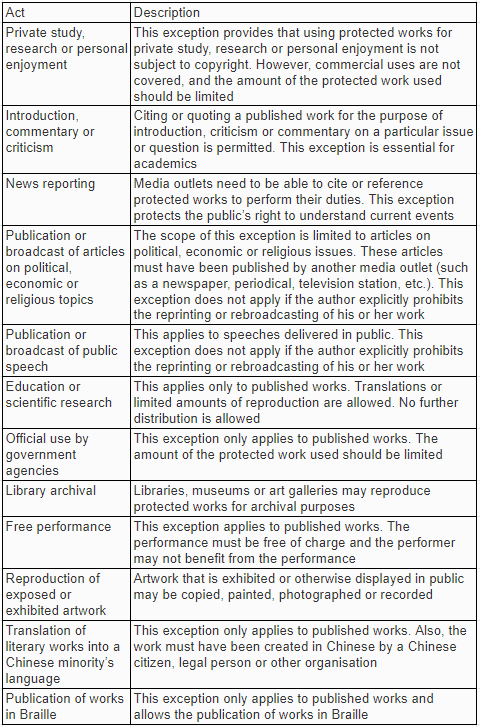
There are a number of exceptions to copyright provided in the Copyright Law. There are a wide variety of exceptions designed for specific situations. The exceptions permit certain uses of protected works without authorisation or remuneration. However, the author’s name and the work’s title should still be specified.

The exceptions are as follows:

china copyright 1.pngchina copyright 1.png

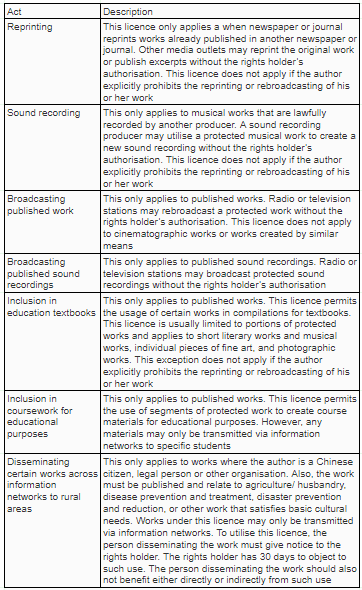
The Copyright Law also includes compulsory licences for certain uses of copyrighted works. These compulsory licences enable certain individuals to use protected works without the authorisation of the copyright owner in exchange for a certain fee. Some of these compulsory licences include:

china copyright 2.pngchina copyright 2.png

Is it permissible to provide a hyperlink to, or frame, a work protected by copyright? If so, in what circumstances?

The Copyright Law does not prohibit hyperlinking to or framing copyrighted work if the work is lawfully uploaded to a server. Such acts do not constitute “dissemination via information network” and do not infringe a rights holder’s exclusive right to disseminate the work via an information network (the Information Network Communication Right). The Information Network Communication Right is derived directly from the right of communication to the public found in Article 8 of the WIPO Copyright Treaty.

Communication to the public refers to the first expression of a work rather than subsequent reiterations or reexpressions. The first act publicises the work. This act may include uploading a work on an open server for public access. Linking to or framing links to protected material merely proliferates the original work by referencing it but does not “disseminate” the work because there is no reproduction or copying. As an extension of this principle, Chinese law prohibits providers from caching copyrighted work on their servers when hyperlinking or framing. Caching is considered infringement of the right to reproduction since caching is a process that necessitates temporal copies. Although hyperlinking to or framing protected work is generally permitted, there are instances where such acts could violate certain competition laws. If there is an economic benefit derived from such exploitation, such as advertising fees, and if the hyperlinking or framing largely replaces the original work, legal liability may arise.

Is a licensee of copyright able to bring an infringement action?

Under the Copyright Law, copyright infringement is actionable by the copyright owner. However, the Copyright Law is silent on a licensee’s authority to bring an infringement action. In practice, exclusive licences imply the right of the licensee to bring an infringement action (unless otherwise stated in the licence). Non-exclusive licensees may only bring an infringement action if the copyright owner expressly grants such right.

Remedies

What remedies are available against a copyright infringer?

The Copyright Law provides the following remedies for rights holders, which a court may order:

  • damages
  • injunctions
  • preliminary injunctions (including orders to cease infringement, and property preservation measures, which can be obtained prior to initiating a copyright lawsuit)
  • mitigation of adverse effects
  • issuance of an apology.

The Civil Procedure Law provides rights holders with interim injunctions (including order to cease infringement and property preservation measures during a copyright lawsuit).

Are there any specific remedies for online copyright infringement?

If an internet service provider (ISP) displays infringing material on its website, rights holders can utilise the notice-and-takedown mechanism in Chinese laws and regulations. The relevant provisions are Article 36 of the Tort Liability Law and Article 14 of the Regulations on Protection of Information Network Communication Right.

The procedure is as follows:

  • rights holder discovers infringing material on an ISP’s website
  • rights holder notifies the ISP to remove the specific infringing material from the website
  • the ISP removes or blocks access to the infringing materials.

If the ISP does not respond after receipt of notice, the rights holder may seek an injunction from a court ordering the ISP to remove or block access to the infringing material.

Under what circumstances is copyright infringement a criminal act and what sanctions may apply?

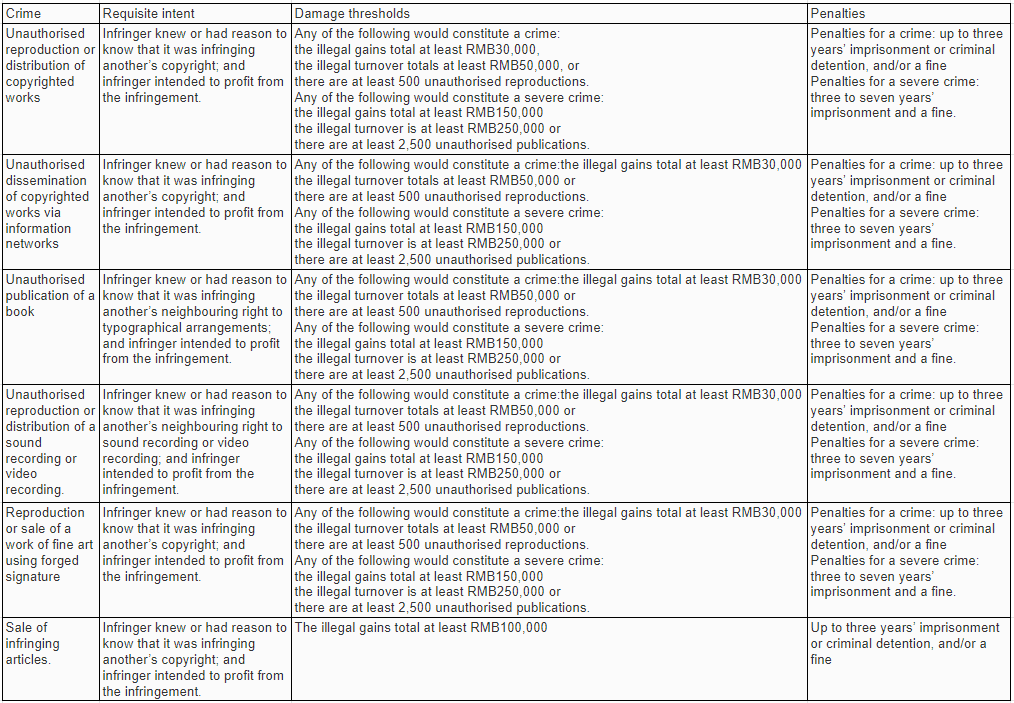
There are a number of criminal violations of copyright law. The main offences are for unauthorised reproduction, distribution or sale of copyrighted works. Dissemination of work via an information network may also be criminal if certain conditions are met. The penalty for committing a criminal copyright offence is generally either a fine and/or imprisonment. If a company commits a criminal copyright offence and an individual officer is shown to have consented to committing such offence, that officer can also be individually liable for the crime. In this circumstance, the company may incur a fine up to three times what the officer is fined. Criminal offences require intent or knowledge. The damage thresholds for each offence also vary. Each offence involves different penalties.

china copyright 3.pngchina copyright 3.png

Is there a time limit for bringing a copyright infringement claim?

As stipulated under the Supreme People’s Court’s Interpretations on Issues Relating to Application of Law in Adjudicating Cases of Copyright Disputes, which became effective in October 2002, the statute of limitations to bring copyright infringement claims was two years from the date of discovery, but has now been extended to three (see below). This date is the date the rights holder is or should have been aware of the infringement. However, if the rights holder brings a lawsuit after expiration of this two-year period, but the infringement is still ongoing when the suit is filed, the court will order the infringer to cease infringement and compensate the rights holder for damages suffered over the preceding two years.

With the General Rules of the Civil Law taking effect in October 2017, the statute of limitations to bring lawsuits for protection of civil rights is generally amended to three years from the date of discovery, unless otherwise provided by law. As copyright is a type of civil right, and there are no other statutes of limitations with respect to copyright infringement otherwise stipulated under other laws, the time limit to bring copyright infringement claims has been extended to three years.

Can legal (or any other) costs be recovered in an action for copyright infringement? If so, what percentage of costs will typically be recovered by the successful party?

Yes. In China, the general rule is that the losing party pays the costs and fees of the prevailing party. These include court fees and the rights holder’s reasonable expenses incurred in stopping the infringement. Courts often support rights holders’ claims to recover investigation costs, notarisation fees and attorney fees as long as the amount is reasonable.

Enforcement

What courts can you bring a copyright infringement action in, and what monetary thresholds, if any, apply?

In China, there are four judicial levels: basic courts, intermediate courts, high courts, and the Supreme People’s Court. Generally, a case will reach its final judgment after being heard by two courts (or two instances). In deciding which court has original or first instance jurisdiction over a copyright case, the value and complexity of the matter is key.

High courts have first instance jurisdiction over copyright cases involving claims greater than RMB200 million, or claims greater than RMB100 million where either party is a foreign citizen, legal person or other organisation or is not domiciled within the court’s jurisdiction.

Basic courts only have jurisdiction over copyright disputes if they are designated by the Supreme People’s Court. Those that are designated have first instance jurisdiction over cases where the claim is under RMB5 million, and cases where the claim is between RMB5 million and RMB10 million but both parties are domiciled in the same place such that the same intermediate or high court would have jurisdiction. The Supreme People’s Court has designated 165 basic courts to hear first instance copyright cases.

Copyright cases not within the jurisdictions of either high courts or basic courts are subject to the first instance jurisdiction of intermediate courts. However, first instance jurisdiction for such cases in Beijing, Shanghai and Guangzhou are reserved with the newly established intellectual Property Courts in those cities.

There is no cap on the amount of damages or costs that can be awarded by a court at different levels. The court can decide damages according to the actual losses suffered by the rights holder. However, if actual losses are hard to determine, the court may award damages according to illegal gains. If the illegal gain is also hard to determine, the court may award statutory damages up to RMB500,000.

Are there any other ways in which you can enforce copyright?

Administrative proceedings A copyright holder may request that the Copyright Bureau (cultural market enforcement team) seize infringing copies of works in the market. Upon the rights holder’s request, the administrative agency may seize and destroy infringing articles, and seize materials, tools, equipment, etc used for producing infringing products. The rights holder may also request that Customs seize infringing products being imported into China or exported overseas.

Criminal proceedings Criminal proceedings, although rare, can be brought by the rights holder against an infringer on the grounds described in 5.3 above. These would be pursued through the courts.

What agency bodies are responsible for promoting and/or enforcing copyright? What do they do?

In China, there are a few collective rights management agencies that grant licences for rights holders. Please see more details in point 6.4. There are no government agencies that promote copyright in China.

The National Copyright Administration of China (NCAC) and its local Copyright Bureaux are the official government bodies responsible for administrative management and enforcement of copyright in China.

The NCAC is responsible for:

formulation of national copyright policies, administration of copyright registrations and compulsory licences negotiation of foreign copyright treaties investigation into material infringement promoting the use of copyrighted software.

In practice, the local Copyright Bureaux often set up cultural market enforcement teams to monitor piracy in the market. These teams have the authority to investigate infringing activities and punish infringers.

The Public Security Bureau (PSB) will target criminal activity (see point 5.3) if it meets the proper thresholds. The PSB may act proactively or reactively upon receiving reports from rights holders or rights management agencies.

What are the main collective rights management agencies that operate in your jurisdiction and who do they represent?

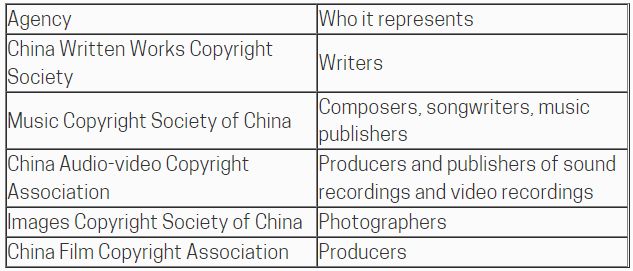
The consent of the rights holder is typically required before using a protected work. However, rights holders may not have the resources to negotiate and issue all individual licence requests. Therefore, rights holders may participate in collection schemes by signing up as members of collective management organisations. As members, these rights holders either transfer certain rights to the society, which then administers the rights for them, or appoint the society as their agent.

The key collecting societies in each sector are as follows: china copyright 4.pngchina copyright 4.png

Are copyright levies payable? By whom, and in what circumstances?

There is no copyright levies mechanism in China.

Copyright reform

What do you consider to be the top recent copyright development?

Chinese Government continues its fight against online copyright infringement The Copyright Law provides administrative protection to copyright holders. Under the law, the Chinese Government may impose a fine on those who seriously infringe another’s copyright. On 26 June 2014, the Shenzhen Market Supervision Administration issued a RMB260 million fine to QVOD Technology Company (QVOD), which marked a milestone in China’s efforts to fight online piracy. The Chinese Government did not slacken thereafter. In July 2017, a campaign named Sword Net 2017 was carried out jointly by four Chinese administrative departments (NCAC, the Internet Information Office of China, the Ministry of Industry and Information Technology of China and the Ministry of Public Security of China (MPS)).

The Sword Net 2017 campaign began in July 2017 and focused on videos, news, mobile internet applications (apps) and e-commerce platforms. Sword Net 2017 was a great success. According to the Government’s official report, 63,000 websites were investigated, 2,554 infringing websites were shut down and 710,000 infringing links were removed by the Government during this campaign, involving an aggregate value of RMB10.7 million.

With the success of Sword Net 2017, the Government has continued with Sword Net 2018, which started in late July 2018. This time, in addition to the continued efforts relating to online movies, online music, e-commerce platforms, app stores and network cloud storage, the Government also focused on the fields of online reposting, short videos, animation, etc.

Additionally, the Chinese Government is maintaining its strong copyright protection for the movie and literature industries, and endeavours to significantly reduce copyright infringement through administrative mechanisms, which it hopes will deter infringers. For instance, each month, the NCAC publishes a warning notice on its official website, listing all movies and TV programmes that will be specially focused on and protected in the following months.

China establishes and continues to enhance the cross-regional adjudicating system for intellectual property cases

Following the establishment of three Intellectual Property Courts (in Beijing, Shanghai and Guangzhou), China established specialised Intellectual Property Tribunals successively in 16 major cities from February 2017 to July 2018, in Nanjing, Suzhou, Wuhan, Chengdu, Hefei, Hangzhou, Ningbo, Fuzhou, and Jinan, Qingdao, Shenzhen, Zhengzhou, Xi’an, Tianjin, Changsha and Nanchang. These 16 newly established Intellectual Property Tribunals, together with the Beijing Intellectual Property Court, Shanghai Intellectual Property Court and Guangzhou Intellectual Property Court, have jointly formed a new “16+3” IP judicial framework in China.

Unlike the Intellectual Property Courts in Beijing, Shanghai and Guangzhou, each of the 16 Intellectual Property Tribunals is established within the system of the intermediate court in the city of its location. Taking Suzhou as an example, the Suzhou Intellectual Property Tribunal was established from the Intellectual Property Tribunal of the Suzhou Intermediate People’s Court and has begun to operate as an independent institution since then.

These 16 Intellectual Property Tribunals have jurisdiction over 13 provinces and municipalities. The establishment of the Intellectual Property Tribunals is a breakthrough compared to the previous tribunals within the people’s courts which exercised territorial jurisdiction set by administrative division, because the Intellectual Property Tribunals have cross-regional jurisdiction over the first-instance intellectual property cases in various cities located in their respective jurisdictions. For example, the Suzhou Intellectual Property Tribunal has jurisdiction over first-instance patent cases and other technology-related civil cases that take place in the following four cities; Suzhou, Wuxi, Changzhou and Nantong.

What do you consider will be the top copyright developments in the next year?

The establishment of Internet Courts In August 2017, China’s first Internet Court was formally established in Hangzhou. After a year of operation and exploration, the Beijing Internet Court and the Guangzhou Internet Court were also established in September 2018 to adjudicate first-instance cases relating to internet-related disputes within their jurisdictions.

Internet Courts are equipped with an online litigation platform. Generally, court proceedings such as case acceptance, document service, mediation, evidence exchange, pretrial preparation, court hearings and judgment announcement shall be completed online. It is worth mentioning that the Hangzhou court has begun to confirm the authenticity of the evidence through new technologies such as electronic signature, trusted timestamping, hash value verification and blockchain. This presents an undoubted trend in favour of copyright owners, who often face difficulties in collecting and authenticating evidence in online infringement cases.

By issuing the Regulations on Several Issues in the Adjudication of Cases at Internet Courts, the Supreme People’s Court clarified that the Internet Courts have jurisdiction over the following copyright cases: (i) disputes over the ownership of copyrights or neighbouring rights to works first published online; and (ii) disputes arising from online infringement on the copyrights or neighbouring rights of works published or distributed online.

The establishment of Internet Courts is a milestone in judicial reform in China. The internet era has witnessed the emergence of a large number of novel disputes and challenges in the field of copyright enforcement. The creation of the Internet Courts is also a positive attempt to solve the difficulties in evidence production in online copyright disputes.

Regulations on copyright protection of folklore China is an ancient civilization with many traditions and a rich cultural history. Chinese folklore is the pinnacle of Chinese classical literature and includes folklore stories, mythology, songs, poetry, dances, puppetry, sculpture, architecture, etc.

The Copyright Law authorises the State Council to formulate regulations to protect folklore. After years of discussion, the NCAC finally published the first draft of the Regulations on Copyright Protection of Folklore on 2 September 2014 for public comments. These regulations are aimed at protecting folklore, promoting communication of folklore, and encouraging its development. A few important points are listed below:

  • the ownership of folklore belongs to the specific ethnic group or community who creates it
  • the copyright holder of folklore enjoys the right to be identified as its author, to protect it from distortion, to reproduce, distribute, perform, adapt and communicate it to the public
  • the duration of folklore protection is perpetual.

The NCAC is receiving comments from various interested parties. The draft will be further revised before it is put into effect. The passage of the regulations will be a significant development in the protection of folklore in China.

Neighbouring rights

Neighbouring rights by type

The neighbouring rights associated with typographical arrangements include the right to authorise or prohibit another’s use of layout designs contained in published works.

The neighbouring rights of performers are:

  • to be identified as the performer
  • to protect his or her performance from distortion
  • to transmit the performer’s live performance via live broadcast and public transmission
  • to make an audio or visual recording of the performance
  • to reproduce and/or distribute an audio or visual recording of their performance
  • to disseminate their performance via an information network.

The exclusive rights of a producer of an audio or visual recording are:

  • to reproduce the audio or visual recording
  • to distribute the audio or visual recording, ie copy the recordings
  • to rent the audio or visual recording, ie authorise others to temporarily use the recordings
  • to disseminate the audio or visual recording via an information network.

The exclusive rights of broadcasters are:

  • to rebroadcast radio or television programmes
  • to record radio or television programmes that they have transmitted through an audio or visual medium, and to reproduce such media.

Terms of neighbouring rights

The term for typographical arrangements is 10 years. The term of protection ends on 31 December of the 10th year after the first publication date of the book or periodical that uses the typographical arrangement.

Performers’ neighbouring rights vary. The performer’s moral right of attribution and the right to protect the performance from distortion are perpetual. The term for a performer’s other economic rights is 50 years. The term ends on 31 December of the 50th year after the first performance.

The term of a producer’s neighbouring rights to audio or visual recordings is 50 years and ends on 31 December of the 50th year after the first recording is created.

The duration for broadcasters’ neighbouring rights is 50 years and ends on 31 December of the 50th year after the first broadcast.

Disclaimer: This guide contains summaries of general principles of law. It is not a substitute for specific legal advice and should not be relied upon in relation to the application of the law or subject matter covered.