TerraLex Cross-Border Guide to Cross-Border Copyright Guide

We are delighted to present the TerraLex cross-border copyright guide 2019

Copyright rules across national boundaries are becoming increasingly relevant to businesses, particularly as the digital market makes its impact felt on all industry sectors. Issues such as digital content portability, pirated content and copyright licensing models now appear high on legislative agendas around the world and businesses need to be nimble enough to operate in an environment in which the creative industries operate globally, but copyright law still varies by jurisdiction.

This Guide draws together contributions from copyright experts in territories we have found are key to global businesses. We hope you will find the Guide a useful resource for getting to grips with the framework of copyright law in each of those territories, safe in the knowledge that if further specialist advice is needed, it’s only a call or email away.

We hope you find it a helpful resource – and do get in touch with any national or international copyright issues that you think we may be able to assist with.

How to Use: You can use the tools below to create bespoke reports for the jurisdiction(s) and topic(s) covered. Click into single jurisdiction for one location or use the compare tool to compare multiple jurisdictions. Select the jurisdictions and topics of interest to create your unique report. You also have the option to print or download using the ellipsis button in the top right corner.

Germany Cross-Border Copyright Guide Guide

Date posted:
10/10/2022
Last update:
27/10/2026

Legislation and regulations

What are the main sources of copyright law?

The main source of copyright legislation in the Federal Republic of Germany is the Act on Copyright and Related Rights (Copyright Act of 9 September 1965). There are some further legal statutes like the Verwertungsgesellschaftengesetz (VGG) or the Verlagsgesetz that govern performing rights associations and the relationship between publishers and authors. Furthermore, there are international conventions by which the Copyright Act has been ratified, such as the revised Berne Convention on Industrial Property or TRIPS.

Subsistence of copyright

What type of subject matter can be protected by copyright?

Article 2 of the Copyright Act defines works as the author’s own intellectual creations, and contains a list of protected works in literary, scientific and artistic domain. This list is not exhaustive.

Literary works

The Copyright Act protects literary works, such as written works, speeches and computer programs. Literary works include all individual linguistic creations such as scientific writings, lectures, prose and plays, including libretti for operas. Excluded from copyright protection are official publications such as court decisions.

Musical works

Musical works are works consisting of music, without any words or actions that are intended to be performed with the music. Music is defined as a combination of sounds for listening to. It is not the same as mere noise.

Pantomimic works

By pantomimic works (including works of dance), thoughts, feelings and stories are expressed through individual movements and gestures.

Artistic works

Artistic works include works of architecture and of applied art and drafts of such works that are of an individual characteristic and have a distinctive element. Mere functional features are not protected by copyright.

Photographic works

Photographic works are protected (including works produced by processes similar to photography) which express a particular artistic conception.

Cinematographic works

Cinematographic works are protected (including works produced by processes similar to cinematography) which contain an intellectual creation.

Illustrations of a scientific or technical nature

Illustrations of a scientific or technical nature (such as drawings, plans, maps, sketches, tables and three-dimensional representations) are protected.

Articles 3 and 4 of the German Copyright Act contain further types of works that can be protected:

Adaptations

Translations and other adaptations of a work which are the adapter’s own intellectual creations are protected as independent works without prejudice to the copyright in the adapted work. The insubstantial adaptation of an unprotected musical work is not protected as an independent work.

Collection works

Collections of works, data or other independent elements which by reason of the selection or arrangement of the elements constitute the author’s own intellectual creation (collections) are protected as independent works without prejudice to an existing copyright or related right in one of the individual elements.

Database works

A database work within the meaning of the German Copyright Act is a collection whose elements are arranged systematically or methodically and the individual elements are individually accessible by electronic or other means. A computer program (Article 69a Copyright Act) used in the creation of the database work or to provide access to its elements does not constitute an integral part of the database work.

Furthermore, Art. 69a of the German Copyright Act contains a regulation for protection of computer programs.

Computer programs

Computer programs are programs of any form, including the drafts and their preparatory design material. Protection applies to any form of a computer program if it represents individual works (ie they are the result of the author’s own intellectual creation).


What is required for works to qualify for copyright protection?

Only the author’s own intellectual creations constitute works within the meaning of the Copyright Act. That means the protected works, by their nature, represent a particular artistic creation or a particular concept.

A certain minimum standard of effort is necessary to qualify a work for copyright protection.

  • In particular, a work needs to consist of four elements:
  • personal creation: There has to be a result that was made by the creative, formative influence of a human being. A creation is not qualified as personal if it is made by machines or animals
  • perceptible formation: This element differentiates from ideas that are not manifested in any formation. For a perceptible formation, it is sufficient that it is an improvisation
  • intellectual content: The author has to create a world of ideas or emotions that have an “exciting” effect on the observer
  • individual personal character or threshold of originality: A significant level of individuality and originality has to be met. Mere routine acts are not protected. The necessary level of originality varies for the different kinds of works.

As a general rule, Germany provides copyright protection if:

  • the author is a national of Germany, of another Member State of the European Union or of another state covered by Agreement in the European Economic Area, or
  • the work was first published in Germany or a state which is a signatory to one of the various international conventions which Germany is a party to.

In the case of AI generated content, copyright protection depends on the extent to which the work can be considered a personal creation. This depends on the amount of human input in the created result. AI generated content can be considered a personal creation if human influence shapes the output in a sufficient and clearly identifiable manner. This is the case when the creative elements incorporated into the prompting dominate the output to such an extent that the work as a whole can be regarded as the author’s original creation. This will however only be the case in exceptional circumstances, meaning that in most cases AI generated content will not be protected by copyright.

What rights does copyright grant to rights holder?

This question depends upon the agreement between the author as rights holder and a rights holder who has been granted rights by the author. Every rights holder can be granted the right to use a work in a particular manner, but only the author has further rights such as moral rights (see 2.4 below) and some exclusive rights with regard to the work.

The German Copyright Act guarantees the author rights concerning his or her intellectual and personal relationships to the work and in respect of the use of the work. Those are the moral rights of authors and exploitation rights.

The author has the right to exploit their work in material form, which includes:

  • the right of reproduction
  • the right of distribution
  • the right of exhibition.

The author also has the exclusive right to communicate their work to the public in non-material form, which includes:

  • the right of recitation, performance and presentation
  • the right of making the work available to the public
  • the right of broadcasting
  • the right of communication by video or audio recordings
  • the right of communication of broadcasts and of works made available to the public.

Further rights of the author are:

  • right of access to copies of works
  • right of resale
  • right of remuneration for rental and lending.

In case of infringement of copyrights, a rights holder has the following rights:

  • right to require cessation of infringement and to damages
  • notification
  • claim to destruction, recall and release of copies
  • pecuniary compensation
  • right of information
  • entitlement to presentation and inspection.

Are moral rights protected (for example, rights to be identified as an author of a work or to object to derogatory treatment of a work)?

Yes. The German Copyright Act sets out the following moral rights: - right of publication

  • recognition of authorship
  • right to prohibit the distortion or any other derogatory treatment of their work.

Moral rights are applicable to all kind of protected works.

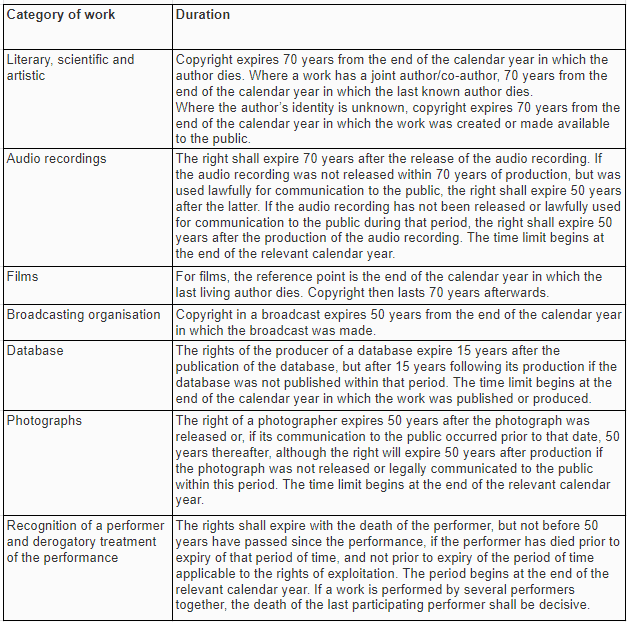
What is the duration of copyright in protected works and other subject matter?

Rights are protected while the author is alive plus 70 years from the time of their death. This rule is valid for works where their author had not been dead for over 70 years in 1965.

germany copyright 1.pnggermany copyright 1.png

For how long do moral rights subsist in copyright works?

An author’s moral right to be identified as the author, to object to derogatory treatment or to privacy lasts for the life of the author plus 70 years.

Ownership

Who is the first owner of a copyright work?

The first owner of the copyright is the author. This even applies if a work was created by a person in the course of their employment. The employee is the author and first owner of the copyright. However, there can be an agreement that the employer has a right of transferring rights of use from the employee. With regard to computer programs, such a right to transfer is granted by Art. 69b of the Copyright Act. The author is the creator of the work. That is the only definition German law provides.

Can copyright in a work be jointly owned? If so, what are the rights of a co-owner?

Copyright in a work can be jointly owned by two or more persons. This can occur where a work is created by more than one person or where there is an assignment of the whole or of part of a work.

To qualify as joint authors it is necessary that the contributions of each author are not distinct. If they are distinct then two works subsist, each with separate copyright.

Joint owners have their own individual rights with respect to the work that can be assigned independently of the other or others, but the consent of all joint authors is required for licensing or use of the copyright work.

Can you register copyright? If so, what are the benefits of such registration and what other steps, if any, can you take to help you bring an infringement action?

Copyright is an unregistered right in Germany; it arises automatically upon creation of the work. There is no registration system that is comparable to the registration of trade marks or patents. However, the author may register his or her work with the German Office for Patents and Trademarks (DPMA) under a pseudonym or even anonymously. Such a registration is useful with regard to the duration of copyright. Furthermore, there is the possibility of a notarial deposit of the protected work. The notarial deed can give proof of the authorship and the date of creation of the protected work. A copyright notice (eg ©) together with the author’s name creates a presumption that the named person is the author.

What steps should you take to validly transfer, assign or license copyright?

No special form has to be met to validly transfer, assign or license copyright. However, a contract by which the author grants rights in respect of unknown types of exploitation, or where he/she undertakes the obligation to do so, must be drawn up in writing. For purposes of evidence, an assignment of copyright must be in writing, signed by or on behalf of the copyright owner.

Can moral rights be transferred, assigned or licensed?

No. Moral rights can be waived but they cannot be assigned.

Infringement

What acts constitute direct infringement of copyright?

Owners of copyright can take legal action if any of their exclusive rights have been infringed. This can be infringement of rights of exploitation or appropriation of a work under its own name (plagiarism). Often rights are infringed by producing and purchasing unlawful copies of works.

German law does not differentiate between primary and secondary infringement as, for example, UK law does.

What acts constitute indirect infringement of copyright?

As stated above, German law does not differentiate between primary and secondary infringement.

What acts are permitted with respect to copyright works (ie what exceptions apply)?

There are a number of acts that can be carried out in relation to copyright works despite the fact that they might be protected by copyright. They include (amongst others):

Text and Data Mining: The reproduction of lawfully accessible works for text and data mining (the automated analysis of digital or digitized works to extract information about patterns, trends, and correlations) is permitted. These copies must be deleted once they are no longer necessary for text and data mining. Rights holders may reserve the right to use the works; however, for works accessible online, this reservation must be made in a machine-readable format.germany copyright 2.png

Is it permissible to provide a hyperlink to, or frame, a work protected by copyright? If so, in what circumstances?

The decision of the German Federal Court of Justice (BGH) ruled that the operator of a homepage does not infringe copyrights if they are embedding on their homepage, via “framing”, content that is available on another homepage for every user of the internet with the permission of that content’s rights owner (Decision dated 9 July 2015, Case I ZR 46/12). However, that case did not deal with the question of what will apply if the content is provided on another homepage without permission of the copyright owner.

Is a licensee of copyright able to bring an infringement action?

An infringement of copyright is actionable by the copyright owner. When copyright is licensed, the authority to bring an infringement action depends on the type of licence involved. An exclusive licence authorises the licensee to exercise a right which would otherwise be exercisable exclusively by the copyright owner. One such right generally is the right to bring an infringement action.

A non-exclusive licensee cannot bring infringement actions unless specifically agreed otherwise with the author. Without that specific agreement, only the author (who remains the copyright holder) is allowed to bring infringement actions.

Remedies

What remedies are available against a copyright infringer?

The German Copyright Act in conjunction with the German Code of Civil Procedure provides the following remedies for the rights holders: - interim injunction (including cease and desist orders, search orders, freezing orders and disclosure orders)

  • bringing an action
  • delivery up of infringing articles
  • seizure or forfeiture of infringing articles
  • customs seizure actions.

Are there any specific remedies for online copyright infringement?

The German Copyright Act does not provide any specific remedies for online copyright infringement. However, the ECJ ruled in its case C-314/12 that internet providers have to block illegal websites if there is a judicial order. Thus, where it appears that a website is displaying illegal infringing material, rights holders can seek an injunction from the court ordering the provider to block the website. However, it is established under German common law that access providers are not obliged to establish barriers for music that is offered unlawfully (OLG Köln, decision dated 18 June 2014, case 6 U 192/11).

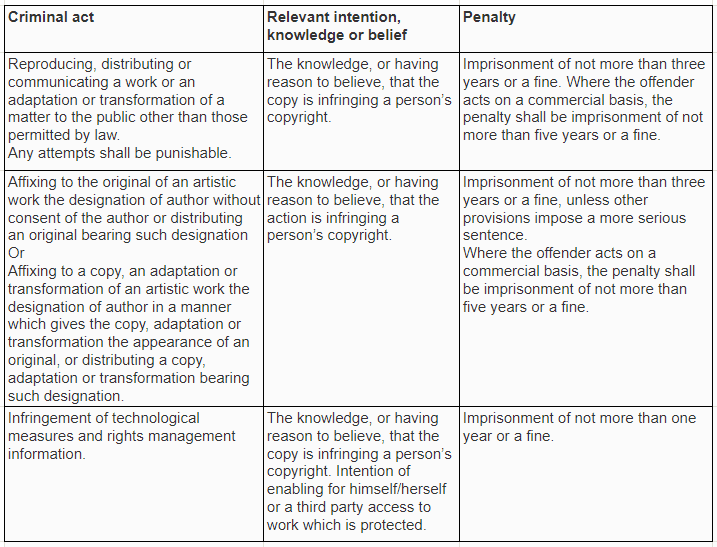
Under what circumstances is copyright infringement a criminal act and what sanctions may apply?

There are a number of criminal acts under the Copyright Act. The sanction for committing a criminal offence in relation to copyright is likely to be a fine and/or a prison sentence. If an offence is committed by a company and it is proven that an individual officer of the company consented to committing the offence, that officer can also be liable for the criminal act. Each offence requires a level of intention, knowledge or belief on behalf of the potential culprit, and each carries various penalties:

germany copyright 3.pnggermany copyright 3.png

Is there a time limit for bringing a copyright infringement claim?

The time limit is three years to bring a breach of copyright. Time begins to run from the end of the year the damage is suffered and of the rights holder’s knowledge of the infringement. Without such knowledge, the limit is 10 years. Interim injunctions must be brought immediately upon rights holders becoming aware of the infringement. The time limit for filing a criminal complaint is three months. Time begins to run from the date of knowledge of the copyright infringement.

Can legal (or any other) costs be recovered in an action for copyright infringement? If so, what percentage of costs will typically be recovered by the successful party?

The general rule in Germany is that the unsuccessful party pays the statutory attorneys’ fees and disbursements of the successful party and court costs. This even applies for costs of a cease and desist letter and in many instances even covers all costs incurred.

Enforcement

What courts can you bring a copyright infringement action in, and what monetary thresholds, if any, apply?

Civil law matters can be brought to ordinary courts. If the claim is worth less than €5,000, the action has to be brought to the local court. If the claim is worth €5,000 or more, action has to be brought to the regional court. Recourse to the courts is permitted in respect of all legal disputes by means of which a claim is asserted on account of a legal relationship regulated under the Copyright Act. As regards copyright litigation matters resulting from employment or service relationships which have as their object only claims for payment of an agreed remuneration, recourse to the labour courts and the administrative courts shall remain unaffected or shall even prevail.

Are there any other ways in which you can enforce copyright?

Customs seizure A copyright holder may request detention and seizure of infringing copies by the Customs authorities.

Arbitration Board under the Law on the Administration of Copyright

The Arbitration Board under the Copyright Administration Law mediates disputes between collecting societies and users of copyright works such as concert organisers, discotheque operators, broadcasting organisations or producers of phonograms. The Arbitration Board is integrated into the German Patent and Trade Mark Office (DPMA). If the parties cannot find an amicable agreement in front of the Arbitration Board, the Board submits a settlement proposal to the parties. If this proposal is not contested, its effect is similar to a court judgment.

Criminal proceedings

Criminal proceedings can be brought on the grounds described in 5.3 above, and pursued through criminal courts.

What agency bodies are responsible for promoting and/or enforcing copyright? What do they do?

The German Patent and Trade Mark Office (together with the Federal Cartel Office – Bundeskartellamt) is the supervision authority of collecting societies that are responsible for promoting and/or enforcing copyright. Collecting societies are subject to government supervision since they have a monopoly position and hold rights in trust. The German Patent and Trade Mark Office acts as the supervisory authority on the basis of the Copyright Administration Law. There are no further agency bodies that actively enforce copyright. The German police or Public Prosecution Department will target criminal activity, but it is up to the rights holder or the rights management agency to spot infringing work and take action.

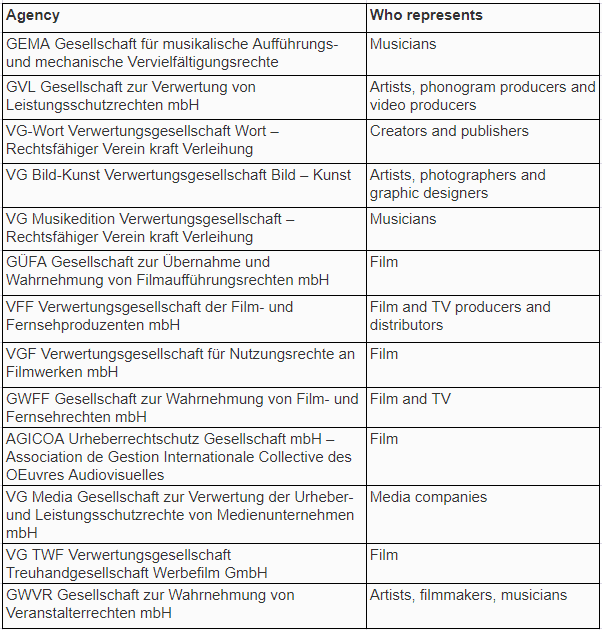
What are the main collective rights management agencies that operate in your jurisdiction and who do they represent?

To use copyright material without infringing the rights of another, you usually need to gain the permission of the rights holder. However, as a result of the practical difficulties and administrative burden for copyright owners in granting licences individually to all those seeking them, copyright holders participate in collection schemes by signing up as members of the collection societies. Once members, they either transfer rights to the collecting society, which then administers the rights for them, or appoint the society as their agent.

The key collecting societies in each sector are as follows:

germany copyright 4.pnggermany copyright 4.png

Are copyright levies payable? By whom, and in what circumstances?

In Germany, copyright levies have to be paid for usage and copying of works protected by copyright law. These are payable as an additional charge together with the surcharge on the price for the devices or media with which copies can be made. The copyright levy is mostly payable as a lump sum, which means that the customer does not need to pay a levy for every single use of the relevant device/media.

Copyright reform

What do you consider to be the top recent copyright development?

In its ruling dated July 31, 2026, the Landgericht München I largely ruled in favor of GEMA in its legal dispute with the AI music developer Suno. The court prohibited the company from reproducing protected works without a license, which also includes their use as training material for AI. Since the generator produced songs that closely resembled the originals, the court found that the copyrighted data had been stored in an unauthorized manner.

One question that has been the subject of high-profile court decisions recently is when a utilitarian object is protected as a work of applied art under Section 2(1)(4) of the German Copyright Act (UrhG). Key precedents in this regard were, on the one hand, the Federal Court of Justice’s (BGH) decision in the Birkenstock case and, on the other hand, the European Court of Justice’s (ECJ) decision in the dispute between USM and Konektra. These rulings established that a certain level of intellectual effort is required to justify copyright protection.

In the Birkenstock decision, for example, it was held that the aesthetic effect of the design can only justify copyright protection to the extent that it is based on and expresses an artistic achievement. Purely technical creations using formal design elements are not eligible for copyright protection; rather, a level of creative originality that demonstrates individuality must be achieved for copyright protection to apply.

In the USM v. Konektra case, the European Court of Justice held that, when assessing the originality of objects of applied art, no higher standards should be applied than for other types of works. Accordingly, a work of applied art is an object that reflects the personality of its creator by expressing the creator’s free and creative decisions. However, decisions that are dictated, in particular, by technical constraints are not considered free and creative. Circumstances such as the author’s intentions during the creative process, his sources of inspiration, and the likelihood of an independent, similar creation are neither necessary nor decisive for assessing the originality of the object for which protection is sought.

What do you consider will be the top copyright developments in the next year?

A potential ruling by the German Federal Supreme Court to clarify exactly to what extent AI-generated content is eligible for copyright protection under Article 2(II) of the German Copyright Act (UrhG). To date, it has been determined on a case-by-case basis whether a work contains sufficient original creative contribution to be covered by Article 2(II) of the UrhG. This makes it difficult to assess whether AI-generated work is protected by copyright or not.

Neighbouring rights

Neighbouring rights by type

N/A

Terms of neighbouring rights

N/A

Disclaimer: This guide contains summaries of general principles of law. It is not a substitute for specific legal advice and should not be relied upon in relation to the application of the law or subject matter covered.