TerraLex Cross-Border Guide to Cross-Border Copyright Guide

We are delighted to present the TerraLex cross-border copyright guide 2019

Copyright rules across national boundaries are becoming increasingly relevant to businesses, particularly as the digital market makes its impact felt on all industry sectors. Issues such as digital content portability, pirated content and copyright licensing models now appear high on legislative agendas around the world and businesses need to be nimble enough to operate in an environment in which the creative industries operate globally, but copyright law still varies by jurisdiction.

This Guide draws together contributions from copyright experts in territories we have found are key to global businesses. We hope you will find the Guide a useful resource for getting to grips with the framework of copyright law in each of those territories, safe in the knowledge that if further specialist advice is needed, it’s only a call or email away.

We hope you find it a helpful resource – and do get in touch with any national or international copyright issues that you think we may be able to assist with.

How to Use: You can use the tools below to create bespoke reports for the jurisdiction(s) and topic(s) covered. Click into single jurisdiction for one location or use the compare tool to compare multiple jurisdictions. Select the jurisdictions and topics of interest to create your unique report. You also have the option to print or download using the ellipsis button in the top right corner.

India Cross-Border Copyright Guide Guide

Date posted:
10/10/2022
Last update:
28/04/2025

Legislation and regulations

What are the main sources of copyright law?

The Copyright Act 1957 (the Act), supported by the Copyright Rules 1958 (the Rules), is the governing law for copyright protection in India. Substantial amendments were carried out to the Copyright Act in 2012. India follows a common law legal system, so relies on case law to interpret and set precedents in law and so the judicial decisions contribute to the sources of copyright law in India. India is a member of the Berne Conventions and Universal Copyright Convention. The Government of India has also passed the International Copyright Order, 1999. According to this Order, any work first published in any country that is a member of any of the above conventions is granted the same treatment as if it was first published in India.

Subsistence of copyright

What type of subject matter can be protected by copyright?

Copyright subsists throughout India in the following classes of works: - original literary, dramatic, musical and artistic works

  • cinematograph films
  • sound recordings.

These are the broad categories, and can be summarised as follows:

Literary works

The term “literary works” encompasses all works that are in print or writing, irrespective of the quality or style of the work. Literary work refers not only to works of prose and poetry, but anything that would be under the ambit of “literature”. However, there will be no copyright if the work is merely a collection of words, the collection of which involved no literary skill. In India, a computer program is treated as a literary work and is protected as such.

Dramatic works

A dramatic work includes any piece for recitation, choreographic work or entertainment in dumb show, the scenic arrangement or acting form of which is fixed in writing or otherwise but does not include a cinematograph film.

Musical works

Musical work means a work consisting of music and includes any graphical notation of such work but does not include any words or any action intended to be sung, spoken or performed with the music. A musical work need not be written to enjoy copyright protection.

Artistic works

Artistic work means a painting, a sculpture, a drawing (including a diagram, map, chart or plan), an engraving or a photograph, whether or not any such work possesses artistic quality; a work of architecture; and any other work of artistic craftsmanship. Any colour scheme, layout or arrangement of any alphabets or features qualifies as an artistic work.

Cinematograph films

Cinematograph film means any work of visual recording on any medium produced through a process from which a moving image may be produced by any means and includes a sound recording accompanying such visual recording; “cinematograph” shall be construed as including any work produced by any process analogous to cinematography including video films.

Sound recordings

Sound recording means a recording of sounds from which sounds may be produced regardless of the medium on which such recording is made or the method by which the sounds are produced. A phonogram and a CD-ROM are sound recordings.

What is required for works to qualify for copyright protection?

Any work which falls under any of the categories mentioned above. The work seeking to be copyrighted must be original; however, it is not necessary that the work should have some original thought or idea. The law is only concerned about the originality of the expression of thought.

What rights does copyright grant to rights holder?

A copyright grants protection to the creator and his or her representatives for the works and prevents such works from being copied or reproduced without their consent.

The creator of a work can prohibit or authorise anyone to:

  • reproduce the work in any form, such as print, sound, video, etc
  • use the work for a public performance, such as a play or a musical work
  • make copies/recordings of the work, such as via compact discs, cassettes, etc
  • broadcast it in various forms
  • translate the same to other languages.

Are moral rights protected (for example, rights to be identified as an author of a work or to object to derogatory treatment of a work)?

Yes, the Act grants an author special rights which exist independently of the author’s copyright, and subsist even after the assignment (whole or partial) of said copyright. The author has the right to:

  • claim authorship of the work
  • restrain or claim damages with respect to any distortion, mutilation, modification, or other act in relation to the said work if such distortion, mutilation, modification, or other act would be prejudicial to their honour or repute.

These special rights can also be exercised by the legal representatives of the author.

The right against distortion, mutilation, or modification is available to the author even after the expiry of the term of copyright.

What is the duration of copyright in protected works and other subject matter?

The duration of protection for copyright works varies according to the type of work and the date of creation as follows:

(a) Literary, dramatic, musical, or artistic works: Copyright expires 60 years from the end of the calendar year in which the author dies. Where a work has a joint author/co-author, it expires 60 years from the end of the calendar year in which the last known author dies. Where the author's identity is unknown, copyright expires 60 years from the end of the calendar year in which the work was first published. If the author's identity is disclosed during the 60 year period, the copyright expires 60 years from the end of the calendar year in which the author dies.

(b) Cinematograph Films: Copyright subsists until 60 years from the beginning of the calendar year following the year in which the film is published.

**(c) Sound Recordings: ** Copyright subsists until 60 years from the beginning of the calendar year following the year in which the sound recording is published.

For how long do moral rights subsist in copyright works?

An author's moral right, which is a right against distortion, mutilation, or modification, or other acts prejudicial to the author's honour or reputation, is available even after the expiry of the term of copyright.

Ownership

Who is the first owner of a copyright work?

The concept of “first owner” Indian copyright law is quite important and may be determined as follows: In the case of a literary, dramatic or artistic work (which includes a photograph, painting or a portrait) created during the course of employment or under a contract of service or apprenticeship, for the purpose of publication in a newspaper, magazine or similar periodical, the author of such a publication shall, in the absence of a contract to the contrary, be the first owner of copyright. However, such ownership shall vest with the proprietor of the publication only for the limited purpose of publishing the work or a reproduction of the work in a publication and, for all other purposes, the copyright shall vest with the author of the work.

If a photograph, painting or portrait has not been made for the purposes of publication in a periodical but has been made for any other purpose, then in the absence of a contract to the contrary, the copyright in such work shall vest with the person at whose instance the work was created.

In the case of a cinematograph film, in the absence of a contract to the contrary, the copyright in the cinematograph film shall vest with the producer of the film (ie the person at whose instance the film was made for a valuable consideration).

In the case of a work made during the course of employment or under a contract of service or apprenticeship, the employer shall, in the absence of a contract to the contrary, be the first owner of copyright. In the case of a government work, the copyright in the work shall vest with the Government.

Can copyright in a work be jointly owned? If so, what are the rights of a co-owner?

As per the Act, work of joint authorship means a work produced by the collaboration of two or more authors in which the contribution of one author is not distinct from the contribution of the other author or authors. Thus, the Act recognises joint authorship. Joint authors fully enjoy all of the rights granted by the Act, as mentioned previously. The term of copyright of a work of joint authorship is calculated with respect to the author that dies last.

Can you register copyright? If so, what are the benefits of such registration and what other steps, if any, can you take to help you bring an infringement action?

Under Indian law, registration is not a prerequisite for acquiring a copyright in a work. A copyright in a work is created when the work is created and given a material form, provided it is original.

However, the Act provides a procedure for copyright registration. Such registration does not confer any special rights or privileges with respect to the registered copyrighted work. It is however suggested that the owner of such original works register it as the certificate of registration of copyright and the entries made on the Register serve as prima facie evidence in a court of law when a dispute relating to ownership of copyright arises. Copies of the entries and extracts from the Register that are certified by the Registrar of Copyrights are admissible as evidence in all courts. Thus, registration only raises a presumption that the person in the Register is the actual author, owner or rights holder. In infringement suits and criminal proceedings, when time is of essence to obtain urgent orders, registration is of tremendous help. Copyright notice is not necessary under Indian law to claim protection.

What steps should you take to validly transfer, assign or license copyright?

An assignment of copyright shall be valid only when it is in writing, signed by the assignor or by his/her duly authorised agent.

Can moral rights be transferred, assigned or licensed?

No; moral rights cannot be transferred or assigned.

Infringement

What acts constitute direct infringement of copyright?

A copyright is infringed if a person without an appropriate permission or licence does anything that the owner of the copyright has an exclusive right to do.

Direct infringement occurs where a person performs any of the following acts without the consent of the rights holder:

  • copying
  • issuing copies of the work to the public
  • renting or lending the work to the public
  • performing, showing or playing a copyright work in public
  • communicating the work to the public
  • making an adaptation of a copyright work or doing any of the acts listed above in relation to an adaption.

What acts constitute indirect infringement of copyright?

Indirect infringement occurs where a person, with knowledge or reasonable grounds for such knowledge, carries out any of the following actions in relation to infringing copies of the work:

  • makes for sale or hire, or sells or lets for hire, or by way of trade displays or offers for sale or hire
  • distributes either for the purpose of trade or to such an extent as to affect prejudicially the owner of the copyright
  • by way of trade exhibits in public
  • imports into India.

What acts are permitted with respect to copyright works (ie what exceptions apply)?

Under the Act there are certain circumstances which constitute fair dealing, which is not considered an infringement. The lists of non-infringing acts are summed up below:

Table

Is it permissible to provide a hyperlink to, or frame, a work protected by copyright? If so, in what circumstances?

The Act does not explicitly address hyperlinking as a form of copyright infringement. However, hyperlinking would not constitute infringement if the linked content were freely available for use by any person. On the other hand, if the content specifically prohibits distribution without authorisation of the copyright holder, then linking to such content without authorization may amount to copyright infringement.

Additionally, if the hyperlink directs to content that itself infringes on another party's copyright, the act of creating the hyperlink may also be considered infringement under the Act.

Is a licensee of copyright able to bring an infringement action?

Under the Act, and infringement of copyright is actionable by the copyright owner. When copyright is licensed, the authority to bring an infringement action depends on the nature of the licence.

An exclusive licence authorises the licensee to exercise a right which would otherwise be exercisable exclusively by the copyright owner. One such right is the right to bring an infringement action.

A non-exclusive licensee may also bring an infringement action but only where the licence is in writing and signed by the copyright owner and expressly grants the non-exclusive licensee the right of action.

Remedies

What remedies are available against a copyright infringer?

The Act provides the following remedies for copyright infringement:

  • civil
  • criminal
  • administrative.

However, it is only the first two remedies, civil and criminal, which are of any real practical importance. Under civil remedies, one may file for interlocutory injunction, pecuniary remedies, Anton Piller orders, Mareva injunction and accounts rendition, delivery of infringing copies and damages for conversion. Under criminal remedies, one may file for imprisonment and fine, seizure of infringing copies and delivery of them to the owner. Under administrative remedies, one may file for moving the Commissioner of Customs to ban the import of infringing copies and delivery of the confiscated infringing copies to the owner.

Are there any specific remedies for online copyright infringement?

A court can direct that infringing websites be blocked by internet service providers either as part of a John Doe order or a website-blocking order. The Act mandates that any person who circumvents an effective technological measure applied for the purpose of protecting any of the rights under the Act, with the intention of infringing such rights, shall be punishable.

Under what circumstances is copyright infringement a criminal act and what sanctions may apply?

The Act prescribes that the intentional infringement or abetment of an infringement of the copyright in a work would be considered as criminal act. Criminal remedies for copyright infringement include:

  • punishment through imprisonment which may not be less than six months but which may extend to three years
  • fines which shall not be less than Rs. 0.05 million and which may extend to Rs.0.2 million
  • search and seizure of the infringing goods including plates, which are defined as including blocks, molds, transfers, negatives, duplicating equipment or any other device used or intended to be used for printing or reproducing copies of the work
  • delivery up of infringing copies or plates to the owner of the copyright.

Is there a time limit for bringing a copyright infringement claim?

The limitation for bringing a copyright infringement claim is three years from the date of infringement.

Can legal (or any other) costs be recovered in an action for copyright infringement? If so, what percentage of costs will typically be recovered by the successful party?

Under the Act, the plaintiff can seek recovery of all three remedies, namely (a) account of profits (b) compensatory damages and (c) conversion damages, which are assessed on the basis of value of the article converted.

Enforcement

What courts can you bring a copyright infringement action in, and what monetary thresholds, if any, apply?

Every suit or civil proceeding in respect of the infringement of copyright can be instituted before a District Court or above.

Are there any other ways in which you can enforce copyright?

The Copyright Board is a body constituted by the Central Government to discharge certain judicial functions under the Act. The Board is entrusted with the task of adjudication of disputes pertaining to copyright registration, assignment of copyright, grant of licences in respect of works withheld from public, unpublished Indian works, production and publication of translations and works for certain specified purposes. It does not deal with copyright infringement cases or with criminal piracy of copyright works.

What agency bodies are responsible for promoting and/or enforcing copyright? What do they do?

In India, the Copyright Office is the government body responsible for promoting and enforcing copyright. The Office is under the control of the Registrar of Copyrights who acts under the direction of the Central Government. Specifically, the Copyright Office is under the aegis of the Department of Higher Education, Ministry of Human Resource Development.

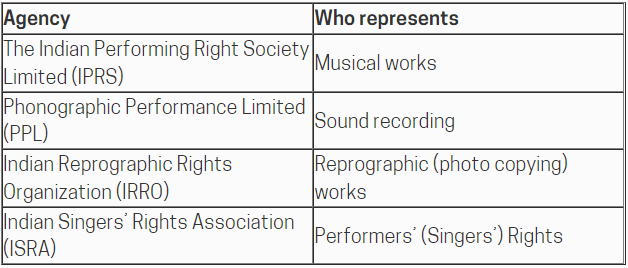
What are the main collective rights management agencies that operate in your jurisdiction and who do they represent?

In India, there are some registered copyright societies which undertake the management and protection of copyright in works of authors and other owners of such works. Some of these are:

india copyright 2.pngindia copyright 2.png

Are copyright levies payable? By whom, and in what circumstances?

The Indian Act does not prescribe any copyright levies.

Copyright reform

What do you consider to be the top recent copyright development?

Question of Employment under Section 17 of The Copyright Act – Neetu Singh v Rajiv Saumitra & Ors [MANU/DE/1912/2018] The Plaintiff, sought permanent injunction against the Defendants from reproducing, publishing, distributing, selling and offering for sale one of the copyrighted literary work “English for General Competitions” and related artistic works, copyright of which was vested in the Plaintiff. The books authored by her were earlier published through Paramount Reader Publication and thereafter Paramount Reader Publication OPC Pvt. Ltd. Paramount Reader Publication was given the right to publish the books, the same never being licensed, assigned or transferred to any of the Defendants. Copyright in the books vested in the Plaintiff, this fact being in the knowledge of the Defendants was never objected by them.

The Plaintiff’s book illegally published by Defendant was a verbatim copy incorporating all artistic works and mistakes originally appearing. The Plaintiff contended that in absence of contract of service between parties and the fact of copyright in her favour was prima facie evidence of her authorship of the book.

In dealing with the issue whether a contract of service, as per Section 17 of the Act, existed between the Parties, the Court dealt with fair use provision and distinguished between works for course of instruction and for commercial purposes, and held that the Defendant’s act of selling books to students after copying the study material amounts to commercial activity and thus cannot be deemed as fair use. The Plaintiff’s employment can be determined by Articles of Association and the agreement, which, being absent, the Plaintiff was held to be owner of copyright. Therefore, in case of a dispute regarding copyright between employer and employee, the terms of employment are relevant.

Delhi University Photocopying Case – The Chancellor, Masters & Scholars of University of Oxford & Ors v Rameshwari Photocopy Service & Ors [MANU/DE/3285/2016]

The Court restrained Rameshwari Photocopy Service from photocopying copyrighted work based on a petition filed by the Appellant publishers. The Appellants alleged that the kiosk was violating their copyright and was causing huge financial losses, as students instead of buying textbooks were relying on the photocopies. . The Court held that photocopying portions of books for personal use would amount to fair use and copyright not being the divine right, the ban was revoked, and the case dismissed.

An appeal was filed to the Higher Bench of Delhi High Court wherein interim injunction was refused to the Appellants and the Court held that the Defendants did not infringe the copyright as their work was justified by purpose of educational instruction. The matter was remanded to single bench of the Court to determine the necessity of copyrighted material in course packs for educational instruction. The Court considered the inability of economically disadvantaged students to purchase different books and revoked the ban, which was hailed by the studnets as a means of easy access to education.

Right to Dub Included In Right to Communicate To Public Mr Thiagrajan Kumararaja v M/s Capital Film Works (India) Pvt Ltd, S.P. Charan Citation: MANU/TN/3844/2017

The Appellant contended that he had authorized the producer to use his script for making a cinematograph film in Tamil language alone, and not remake or dub the film in any other language.

On dismissal, the Appellant filed an appeal for permanent injunction against the Respondents on the ground that since the rights were not assigned, the producer could not dub and make another film under Section 19 of the Act.

The Respondents contended that dubbing constituted the “right to communicate the film to public” under section 14 (d) (iii) of the Act, they paid consideration for the script, and thus being the first authors, converted it into a cinematograph film with consent of the Appellant.

The Court held that under Section 14 of the Act, the producer is the author of the film and has the right to make its copy, sell or give it on hire or offer for sale or hire and also communicate it to public, which includes dubbing. It was observed that “otherwise enjoys”, provided under Section 2(ff) enlarges the scope of usage of right and enables the Respondent to dub the movie in language of his choice for communication to public.


What do you consider will be the top copyright developments in the next year?

Petition Filed in the Supreme Court to Challenge Constitutionality of Provisions on Compulsory and Statutory Licensing in the Copyright Act – M/S Lahari Recording Company v Union of India – Writ Petition(s) (Civil) No(s): 667/2018

In the present petition, the Plaintiff, Lahari Recording Company, has challenged sections 31 (1) (b) and section 31 D of the Act – on the grounds that they infringe the Plaintiff’s fundamental and constitutional rights. While section 31 (1)(b) provides for a system of compulsory licensing of works whose owner has refused to allow their communication to the public on reasonable terms, Section 31 D created a regime for mandatory licensing of works to broadcasting organizations on terms formulated by the Intellectual Property Appellate Board (IPAB).

The essence of the Plaintiff’s petition is that the impugned provisions fundamentally alter the bargain that the copyright system is based on, by taking away the incentive for copyright owners to create original content. The grievance of the Plaintiff is that the Sections 31(1)(b) and 31D of the Act would disrupt the long standing mutually negotiated voluntary license agreements with broadcasters and with the coming of the impugned provisions, such broadcasters would have no incentive to enter into and/or continue with the voluntary license agreements with the labels and instead would attempt to terminate or wriggle out of their agreements with the labels in order to approach the Appellate Board to have terms convenient to them fixed and imposed upon the labels.

The Plaintiff contends that section 31 (1) (b) does not envisage hearing the copyright owner on every occasion on which a compulsory licence is granted to parties considered qualified by the Intellectual Property Appellate Board (IPAB). Similarly, section 31 D envisages the grant of a statutory licence without hearing the copyright owner. This makes these provisions, in Plaintiff’s view, arbitrary and thereby violative of Article 14 of the Constitution of India. Given that section 31 (1) (b) gives IPAB the power to formulate the terms on which a compulsory licence is to be granted by taking away this right from the copyright owner’s remit, the Plaintiff contends that it makes an impermissible inroad into the contractual freedom of copyright owners and unduly constrains the exercise of the rights that are a natural consequence of being a copyright owner.

The Plaintiff also challenges section 31 D on the grounds that the provision removes the relationship between broadcasters and music labels from the realm of commercial negotiation and enables broadcasters to utilise copyrighted content at subsidised and preferential rates. This, the Plaintiff contends, unduly tips the scales in favour of broadcasters by prioritising the commercial profitability of broadcasters over the interests of copyright owners. By virtue of the fact that these provisions unduly constrain the exercise of the rights of copyright owners, the Plaintiff contends that they take away the incentive for a copyright owner to create more original content. On a practical level, the Plaintiff contends that, by virtue of the existence of the statutory licensing route, broadcasters are likely to seek an escape hatch from their contractual arrangements with copyright owners and instead seek to access the statutory licensing route, which is more favourable for them.

The matter is to come up for final hearing and if the Petitioner succeeds by convincing the Supreme Court, this would become a landmark judgment by altering the foundation of Copyright Law.

Neighbouring rights

Neighbouring rights by type

The Act provides for the following nieghbouring rights:

(a) Performers' Rights (e.g., actors, musicians, singers). (b) Producers of Sound Recordings. (c) Broadcasters' Rights.

Terms of neighbouring rights

The neighbouring rights provided under the Act are exercisable for the following terms:

(a) Performers' Rights - Protected for 50 years from the calendar year following the year of performance. (b) Producers of Sound Recordings - Protected for 50 years from the calendar year following the year of publication. (c) Broadcasters' Rights - Protected for 25 years from the calendar year following the year of broadcast.

Disclaimer: This guide contains summaries of general principles of law. It is not a substitute for specific legal advice and should not be relied upon in relation to the application of the law or subject matter covered.