TerraLex Cross-Border Guide to Cross-Border Copyright Guide

We are delighted to present the TerraLex cross-border copyright guide 2019

Copyright rules across national boundaries are becoming increasingly relevant to businesses, particularly as the digital market makes its impact felt on all industry sectors. Issues such as digital content portability, pirated content and copyright licensing models now appear high on legislative agendas around the world and businesses need to be nimble enough to operate in an environment in which the creative industries operate globally, but copyright law still varies by jurisdiction.

This Guide draws together contributions from copyright experts in territories we have found are key to global businesses. We hope you will find the Guide a useful resource for getting to grips with the framework of copyright law in each of those territories, safe in the knowledge that if further specialist advice is needed, it’s only a call or email away.

We hope you find it a helpful resource – and do get in touch with any national or international copyright issues that you think we may be able to assist with.

How to Use: You can use the tools below to create bespoke reports for the jurisdiction(s) and topic(s) covered. Click into single jurisdiction for one location or use the compare tool to compare multiple jurisdictions. Select the jurisdictions and topics of interest to create your unique report. You also have the option to print or download using the ellipsis button in the top right corner.

Kenya Cross-Border Copyright Guide Guide

Date posted:
15/08/2023
Last update:
15/08/2023

Legislation and regulations

What are the main sources of copyright law?

The main source of copyright legislation in Kenya is the Copyright Act, No 12 of 2001 as amended from time to time, and the Regulations issued in terms of the Copyright Act. The Act was last amended by the Copyright (Amendment) Act, 2022.

As a common law legal system, Kenya also relies on case law to interpret and set precedents in law. As a result, there are a number of judicial decisions that contribute to the sources of copyright law in Kenya.

Subsistence of copyright

What type of subject matter can be protected by copyright?

The categories of work that can be covered by copyright are literary, musical, and artistic works, audio-visual works, sound recordings and broadcasts. These are described in the Act as follows: Literal works Includes, irrespective of literary quality and in whatever mode or form expressed, novels, stories, novels, stories, poems, poems, plays, stage directions, film sceneries, broadcasting scripts, textbooks, treatises, histories, biographies, essays, articles, encyclopedias, dictionaries, letters, reports, memoranda, lectures, addresses, sermons, charts, tables, tables, computer programs and compilations of data (including tables and compilations of data stored and embodied in a computer or a medium used in conjunction with a computer). Excluded from literal works are written law and judicial decisions. In Kenya computer programs are treated are literal works but they are subject to fair dealing.

Musical works Musical work means a work consisting of music and includes any graphical notation of such work but does not include any words or any action intended to be sung, spoken or performed with the music.

Artistic works Artistic works means, paintings, drawings, etchings, lithographs, woodcuts, engravings, prints, maps, plans and diagrams, works of sculpture, photographs not comprised in audio-visual works, works of architecture in the form of buildings or models, works of artistic craftsmanship, pictorial woven tissues and articles of applied handicraft and industrial art.

Audio-visual works The Act defines audio-visual works as a fixation in any physical medium of images, either synchronised with or without sound, from which a moving picture may by any means be reproduced and includes videotapes and videogames but does not include a broadcast.

Sound recordings This means any exclusively aural fixation of the sounds of a performance or of other sounds, or of a representation of sounds, regardless of the method by which the sounds are fixed or the medium in which the sounds are embodied but does not include a fixation of sounds and images, such as the sound track of an audio-visual work.

Broadcasts Broadcasts are the transmission, by wire or wireless means, of sounds or images or both or the representations thereof, in such a manner as to cause such images or sounds to be received by the public and includes transmission by satellite.


What is required for works to qualify for copyright protection?

Any work which falls under any of the categories mentioned above. The work seeking to be copyrighted must be original; however, it is not necessary that the work should have some original thought or idea. The work must also have been written down, recorded, or otherwise reduced to material form.

The Act stipulates that a work can qualify for copyright protection, regardless of whether its creation or any action related to it involves the infringement of copyright in another work. Additionally, the Act specifies that copyright will be granted to a work eligible for protection, provided that the author, or in the case of a jointly authored work, any of the authors, is a citizen of Kenya, domiciled or ordinarily residing in Kenya, or a corporate entity incorporated under or in accordance with Kenyan laws at the time of creating the work.

What rights does copyright grant to rights holder?

A copyright bestows protection upon the creator and their representatives, safeguarding their works from unauthorized copying or reproduction. The creator of a work holds the authority to either permit or forbid anyone from:

  1. reproducing the work in any form, such as print, sound, video, etc
  2. using the work for a public performance, such as a play or a musical work make copies/recordings of the work, such as via compact discs, cassettes, etc
  3. broadcasting it in various forms and translate the same to other languages.

Are moral rights protected (for example, rights to be identified as an author of a work or to object to derogatory treatment of a work)?

Yes, the Act grants the author of a work the right to: 1. claim the authorship of the work; and
2. object to any distortion, mutilation, or other modification of or other derogatory action in relation to, the said work which would be prejudicial to their honour or reputation.

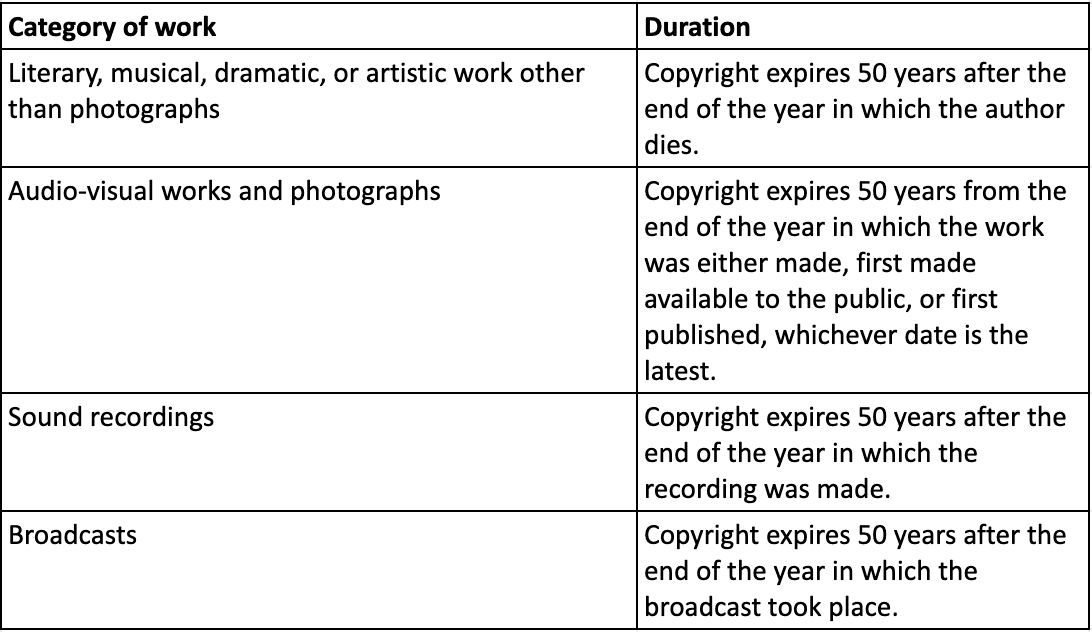
What is the duration of copyright in protected works and other subject matter?

The duration of protection for copyright works is as follows: k-cp-1.pngk-cp-1.png

The Act further provides that:

  1. in the case of a work of joint authorship, the term of protection of a copyright shall be taken to refer to the author who dies last.
  2. copyright in works eligible for copyright and vested in the National Museums Board of Directors or the National Museums is conferred in perpetuity on the National Museums.

For how long do moral rights subsist in copyright works?

Moral rights cease to exist after the death of the author.

Ownership

Who is the first owner of a copyright work?

Copyright is initially vested in the author, but there are exceptions where the copyright ownership may change hands. Firstly, if a work is commissioned by someone who is not the author's employer under a contract of service, the copyright shall be deemed to be transferred to the person who commissioned the work. Secondly, if the work is not commissioned but created by the author during their employment under a contract of service, the copyright will be similarly transferred to the author's employer. However, these transfers are subject to any agreements between the parties that might exclude or limit such transfers.

The term "author" as defined in the Act refers to various scenarios:

  1. For a literary, musical, dramatic, or artistic work, it pertains to the individual who first brings the work into existence or creates it.
  2. In the context of a photograph, it signifies the person responsible for composing the photograph.
  3. Concerning a sound recording, it designates the person who made the arrangements for creating the sound recording.
  4. For audio-visual works, it denotes the person who made the arrangements for producing the work.
  5. Regarding a broadcast, it refers to the first broadcaster.
  6. In the case of a published edition, it relates to the publisher of that edition.
  7. For a computer-generated literary, dramatic, musical, artistic work, or computer program, it signifies the person who undertook the necessary arrangements for creating the work.
  8. Regarding a computer program, it signifies the person who exercised control over the making of the program.

Can copyright in a work be jointly owned? If so, what are the rights of a co-owner?

As per the Act, a work of joint authorship refers to a creation that results from the collaboration of two or more authors, where the individual contributions of each author are not distinct from one another. As a result, the Act acknowledges the concept of joint authorship, and in such cases, all joint authors are entitled to fully enjoy the rights granted by the Act, more particularly, the authority to either permit or forbid anyone from:

  1. reproducing the work in any form, such as print, sound, video, etc.
  2. using the work for a public performance, such as a play or a musical work make copies/recordings of the work, such as via compact discs, cassettes, etc.
  3. broadcasting it in various forms and translate the same to other languages.

In addition to the above, the Act grants the joint authors of a work the moral right to:

  1. claim the authorship of the work; and
  2. object to any distortion, mutilation, or other modification of or other derogatory action in relation to, the said work which would be prejudicial to their honour or reputation.

Can you register copyright? If so, what are the benefits of such registration and what other steps, if any, can you take to help you bring an infringement action?

In Kenya, copyright is established automatically upon the creation of a work, given that it is original and fixed in a tangible form. Although voluntary registration of copyright works is available through the National Rights Registry, the primary advantage of such registration lies in the fact that the recorded entries can serve as prima facie evidence in a court of law during disputes concerning copyright ownership.

What steps should you take to validly transfer, assign or license copyright?

An assignment of copyright or licence for exclusive use must be in writing, signed by or on behalf of the copyright owner. A non-exclusive license to perform an action that falls under copyright control can be established through written or oral agreement, or it may be inferred from one's conduct. Such a license can be revoked at any time. However, if a license is granted through a contract, it cannot be revoked by the licensor or their successor in title unless the contract explicitly allows for it or if there is a subsequent contract that enables the revocation.

Can moral rights be transferred, assigned or licensed?

No. Moral rights can be waived but they cannot be assigned.

Infringement

What acts constitute direct infringement of copyright?

Direct infringement occurs when a person knowingly engages in the following actions while copyright subsists in a work: 1. Producing an infringing copy for sale or hire.
2. Selling, hiring, or offering for sale an infringing copy for commercial purposes. 3. Distributing infringing copies. 4. Possessing an infringing copy for reasons other than private and domestic use. 5. Importing into Kenya an infringing copy for reasons other than private and domestic use. 6. Making or possessing a device intended for making infringing copies. 7. Causing a broadcast to be rebroadcast or transmitted in a diffusion service, knowing it infringes copyright. 8. Causing unauthorized distribution of signals by a distributor, knowing it infringes copyright. 9. Circumventing a technological protection measure or manufacturing/distributing devices designed for such circumvention. 10. Removing or altering rights management information or importing/distributing/making available to the public a work from which such information has been removed or altered.

Additionally, any person who causes the public performance of a literary or musical work, audio-visual work, or sound recording when copyright subsists, and such performance infringes the copyright.

What acts constitute indirect infringement of copyright?

In Kenya, there is no differentiation made between direct infringement and indirect infringement in the Act.

What acts are permitted with respect to copyright works (ie what exceptions apply)?

The Act includes the following exemptions subject to the acknowledgement of the author: 1. fair dealing for purposes of scientific research, private use, criticism, review, or reporting of current events. 2. the use of parody, pastiche, or caricature. 3. the right to quote from a work. 4. use of a work for the purpose of a judicial proceeding or reporting on such proceeding. 5. reproduction, distribution, or inclusion in an audiovisual work or broadcast of an artistic work accessible to the public. 6. the incidental inclusion of a copyright work in an artistic work, sound recording, audiovisual work, or broadcast. 7. public reading or recitation of a reasonable extract from a published literary work, accompanied by sufficient acknowledgement of the author.

According to the Act, fair dealing with computer programs allows the following acts without the authorization of the right holder, provided that copies are necessary for the proper use of the computer program:

  1. making copies of the program to correct errors.
  2. creating a back-up copy.
  3. testing the program to determine its suitability for personal use.
  4. using the program for any purpose that is not prohibited under the relevant license or agreement.

Additionally, the authorization of the right holder of a computer program is not required for the following actions:

  1. decompiling the program to obtain information necessary for enabling it to operate with other programs.
  2. converting the program into a version expressed in a different programming language, code, or notation for interoperability purposes.

The Act further provides the following exemptions:

  1. educational institutions – subject to limitations, published articles, short works, or extracts for teaching purposes in non-commercial educational institutions.

  2. libraries and archives - reproduction of a work by or under the government, public libraries, archives, non-commercial documentation, and scientific institutions for public interest without revenue generation.

Is it permissible to provide a hyperlink to, or frame, a work protected by copyright? If so, in what circumstances?

In Kenya, the Act protects internet service provider (ISP) and provides that they will not liable for damages incurred by a person if they refer or link users to a webpage with infringing material or facilitate infringing activity using information location tools like directories, indexes, references, pointers, or hyperlinks, provided the ISP is unaware of the material infringing the rights of that person and/or the service provider is not aware of the facts or circumstances where the allegedly infringing activity or nature of the material is not obvious

Is a licensee of copyright able to bring an infringement action?

The Act provides that an exclusive licensee or sub-licencee possess the same rights of action and is entitled to the same remedies as if the license were an assignment. These rights and remedies will be concurrent with those of the copyright owner who granted the license and sub-license. However, the Act also requires the owner of the copyright to be given written notice by the exclusive licensee or sub-licensee informing them of their intention to institute proceedings. The owner has the option to intervene in such proceedings and can claim damages resulting from the infringement or seek a reasonable royalty to which they may be entitled.

Remedies

What remedies are available against a copyright infringer?

The Act offers several remedies for copyright infringement, including: 1. Anton Piller Orders that allow the claimant to enter premises to seize and retain records, data, documents, and materials related to the copyrighted works. 2. the court may grant damages, injunctions, and enable the claimant to account for the profits gained by the infringing party from the infringement of the copyrighted work. 3. the court can order the delivery of any article that appears to be an infringing copy or any item used or intended for making infringing copies, if such items are in the possession of the infringing party.
4. instead of damages, the claimant may opt for an award calculated based on a reasonable royalty, equivalent to what a licensee would have paid for the work or type of work in question

Are there any specific remedies for online copyright infringement?

The Act empowers the High Court to issue a variety of orders to tackle online copyright infringement, which includes the following: 1. if an individual is involved in enabling or facilitating copyright infringement or if their service is used by others to infringe copyright, the court can order them to cease such activities or disable access to their service for such infringing purposes. 2. if an individual hosts or provides an online location, service, or facility (whether inside or outside Kenya) that is used for copyright infringement or facilitates such infringement, the court can order them to disable access to that online location, service, or facility, regardless of any changes or movements over time. 3. the court can also instruct an internet service provider to take measures to prevent or impede the use of their service in accessing an online location, service, or facility (whether inside or outside Kenya) that is involved in copyright infringement, regardless of any replacements, amendments, or movements of the location, service, or facility.

Under what circumstances is copyright infringement a criminal act and what sanctions may apply?

Criminal proceedings can be brought on the grounds of intentional infringement or complicity but the right to pursue criminal proceedings rests with the rightsholder. The sanctions that can be levied on an infringing party can be in the way of monetary fines, imprisonment or both. The table below provides some of the offences under the Act:

kenya-copyright-guide-sheet.pdf

Is there a time limit for bringing a copyright infringement claim?

The time limit for bringing a copyright infringement claim is 3 years from the date of the alleged infringement.

Can legal (or any other) costs be recovered in an action for copyright infringement? If so, what percentage of costs will typically be recovered by the successful party?

In Kenya, the prevailing norm dictates that the expenses incurred during legal proceedings are typically borne by the unsuccessful party, unless the court, for valid reasons, decides otherwise. The courts have complete discretion in granting cost awards, yet they exercise this authority judiciously by taking into account the specific facts and circumstances of each case.

Enforcement

What courts can you bring a copyright infringement action in, and what monetary thresholds, if any, apply?

Every suit or civil proceeding in respect of the infringement of copyright can be instituted before a Resident Magistrates Court or above.

Are there any other ways in which you can enforce copyright?

The Copyright Tribunal, established under the Act, is entrusted with the authority to resolve various copyright-related matters. Its main responsibilities include adjudicating disputes over copyright registration, handling appeals concerning the grant of registration certificates, and addressing cases where a collective management organization unreasonably denies granting such certificates. Additionally, the Copyright Tribunal plays a crucial role in determining fair compensation for broadcasting rights holders when their works are incorporated into audio-visual productions by broadcasting authorities. If disagreements arise regarding compensation, the Tribunal is responsible for establishing the appropriate amount. Moreover, the Copyright Tribunal possesses the power to issue necessary orders aimed at preserving crucial evidence, documents, or copies in cases where copyright infringement is suspected.

What agency bodies are responsible for promoting and/or enforcing copyright? What do they do?

The Kenya Copyright Board (KECOBO) established under Act is the primary government agency and it is responsible for the administration, coordination, and enforcement of copyright and related rights in the country. KECOBO undertakes the following in promoting and enforcing copyright:

  1. facilitates the registration of copyrighted works, such as literary, artistic, musical, audiovisual, and software creations.
  2. issues licenses for various uses of copyrighted works and ensures that copyright owners receive fair compensation in the form of royalties for the use of their works by others.
  3. engages in awareness campaigns and educational programs to promote copyright protection and inform creators and the public about their rights and obligations under copyright law.
  4. enforces copyright laws and take legal action against copyright infringement. This may include conducting investigations, issuing warnings, and prosecuting copyright violators. KECOBO inspectors are seconded from the National Police Service and are trained on copyright infringement.
  5. acts as a mediator in copyright-related disputes between creators and users of copyrighted material. It aims to find amicable solutions to conflicts without resorting to lengthy court proceedings.
  6. collaborates with other copyright offices and organizations globally to strengthen copyright protection and ensure that Kenya complies with international copyright agreements.

What are the main collective rights management agencies that operate in your jurisdiction and who do they represent?

In Kenya, the following are the current collective rights management agencies: 1. the Performers Rights Society of Kenya (PRISK) acts on behalf of performers in musical and dramatic works. 2. the Music Copyright Society of Kenya (MCSK) represents authors, composers, arrangers, and publishers of musical works when it comes to public performances and broadcasting. 3. the Kenya Association of Music Producers (KAMP), which advocates for and represents producers of sound recordings. Their membership consists of record labels and entities involved in producing and distributing music.

Are copyright levies payable? By whom, and in what circumstances?

Copyright levies are not payable in Kenya.

Copyright reform

What do you consider to be the top recent copyright development?

The Kenyan government is steadfast in its efforts to establish the country as a prominent technology hub, aiming to attract significant investments. While pursuing this goal, the government recognizes the importance of honoring its international obligations under existing treaties, particularly in relation to copyright issues. One significant stride in this direction was made with the enactment of the Copyright (Amendment) Act No. 14 of 2022. This amendment marks a positive development, particularly concerning revenue distribution, which is a crucial aspect of supporting creators and copyright holders. However, it is important to acknowledge that the amendment neglected to include provisions concerning the issuance of take-down notices by internet service providers, which were in the draft bill. These provisions are essential for addressing copyright infringement and ensuring that online content respects intellectual property rights.

What do you consider will be the top copyright developments in the next year?

Online infringement is expected to emerge as a top concern due to the growing engagement of content creators in the digital realm and the commercialization of online content. As more individuals and businesses enter the digital space, the risk of copyright violations and intellectual property infringements rises significantly.

To address these challenges, it is anticipated that there will be intensified discussions and efforts to bring Kenyan copyright law in line with the country's international treaties. Aligning the copyright framework with these global agreements is crucial to ensure that Kenya fulfils its obligations and provides adequate protection for copyright holders in the digital era.

Neighbouring rights

Neighbouring rights by type

N/A

Terms of neighbouring rights

N/A

Disclaimer: This guide contains summaries of general principles of law. It is not a substitute for specific legal advice and should not be relied upon in relation to the application of the law or subject matter covered.