TerraLex Cross-Border Guide to Cross-Border Guide to Business Investment in Africa

TerraLex is pleased to announce its recent digital publication of a Cross-Border Guide to Business Investment in Africa. Africa’s emerging countries form an integral part of any successful global business strategy and offer tremendous growth opportunities for multinational companies and global entrepreneurs alike. The following guide provides important information businesses need to know while considering their investment into the region.

How to Use: You can use the tools below to create bespoke reports for the jurisdiction(s) and topic(s) covered. Click into single jurisdiction for one location or use the compare tool to compare multiple jurisdictions. Select the jurisdictions and topics of interest to create your unique report. You also have the option to print or download using the ellipsis button in the top right corner.

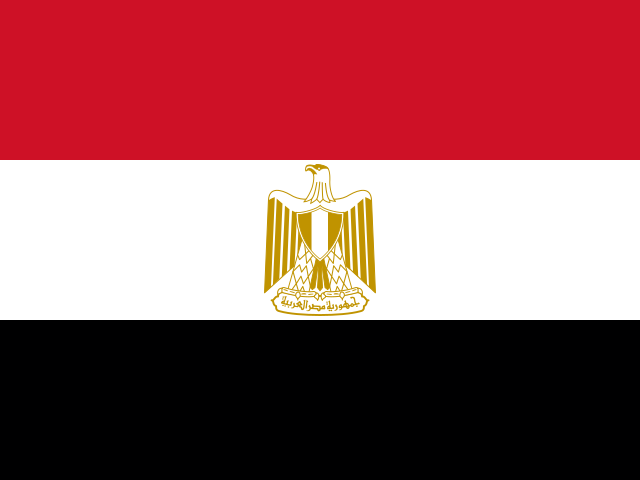
Egypt Cross-Border Guide to Business Investment in Africa Guide

Date posted:
05/10/2023
Last update:
05/10/2023

What type(s) of legal entity(ies) can a foreign investor set up in your country?

The available legal entities are: Limited Liability Company (“LLC”).

Joint Stock Company (“JSC”).

Branch of a Foreign Company. Foreign companies may open branches in Egypt to carry out specific activities such as construction works, hotel management, commercial, financial, and industrial activities, or generally to execute work of a contractual nature, subject to signing a contract with an Egyptian entity to provide the services/work encompassed by such activity; and

Representative Office. Representative offices may only carry out market surveys or production feasibility studies. Such offices may not carry out any commercial operations of any nature whatsoever and may not carry our any revenue generating activities.

What is the principal legislation that governs the various legal entities that an investor can set up in your country?

  • The Companies Law No. 159 of year 1981 and its Executive Regulations No.96 of year 1982, as amended.
  • The Investment Law No. 72 of year 2017 and its Executive Regulations No. 2310 of year 2017, as amended.
  • The Capital Market Law No. 95 of year 1992 and its Executive Regulations No.135 of year 1993, as amended

What is the process of registering each of the proposed entities in your country, and how long does it take?

The registration process and timeframe vary subject to the type of the legal entity, and in certain cases, the type of the activity and the associated licensing requirements. Generally, procedures for the incorporation involve opening of a bank account with a registered bank in Egypt, having registered headquarters in Egypt and submitting documents related to the founders of the newly established entity. Security checks are also carried out by the competent security authorities in Egypt on foreign shareholders and board members. All required incorporation documents must be submitted to the incorporation department at the competent authority for its review and approval on the incorporation. Incorporation of JSCs or LLCs may take up to 5-7 business days from the date all required documents are submitted to the competent authorities in good order. The incorporation process of a branch / representative office may take up to 20 days from the date of submitting the application and relevant documents in good order.

Are there any minimum share capital requirements?

The minimum capital required for the incorporation of JSC is EGP 250,000. As for LLC, there is no minimum capital required. Noting however that the minimum share capital requirements of a JSC and LLC may vary depending on the company’s activities. For the branch or a representative office, the minimum required capital is EGP 5,000.

Are there any exchange control rules governing the flow of funds into and out of your country?

There are currently no foreign exchange controls applicable in Egypt. From a practical perspective, the transferring bank may require submission of documentation substantiating the underlying commercial transaction. Although there are no legal restrictions on repatriation of foreign currency, the main challenge practically is sourcing the foreign currency.

Is there a requirement to have local (nationals) as directors? If so, how many?

As a general principle, there is no limitation on foreign participation in Egyptian companies. That said, subject to the entity’s activities, the appointment of a national director may be required such as companies undertaking commercial agency activities, where all the directors and shareholders must be Egyptians.

Is there any kind of legislation that requires specific demographics for the various legal entities or establishes a quota system (whether gender, ethnicity, race, disability, etc.)?

There is no specific legislation in Egypt that requires specific demographics or establishes a quota system based on gender, ethnicity, race. The Egyptian Constitution of 2014 and the Labor Law No. 12 of 2003 guarantee equal rights and freedom for all citizens (regardless of age, color, or sex) and prohibit discrimination and ensure equal opportunities and treatment.

Are there any periodical statutory reports that the various legal entities would need to file?

The periodical statuary reports include, inter alia: - Foreign Direct Investment Report: all companies operating in Egypt that have foreign shareholders are required to submit a quarterly Foreign Direct Investment Report to GAFI.

  • A JSC/LLC should hold within the three-months following the end of its financial year an ordinary general assembly meeting approving, inter alia, its financial statements and profit distribution (if any), auditor’s appointment. The minutes of such meeting should be filed with the competent regulator for ratification.
  • Tax Returns: all individuals and companies are required to submit an annual tax return to the tax authorities in Egypt.

What are the key labour laws and regulations in your country, that would affect a foreign investor?

The relevant key Labor Laws include: - Egyptian Labor Law No. 12 of 2003

  • Minister of Manpower and Immigration’s Decree No. 146 for the year 2019 concerning conditions and procedures of work permits of foreign employees.
  • Social Insurance Law No. 149 of 2019.
  • Central Administration for Employment’s Decree No. 485 for the year 2010 specifying the executive procedures for the issuance of work permits to foreigners

What are the types of work permits foreign investors and employees need to obtain and what is the process involved in obtaining them?

Work Permit for Foreign Employees: Pursuant to applicable regulations, foreign employees shall not practice any work in Egypt unless necessary work permit issued by the Ministry of Manpower and Immigration is obtained to enter the country and to reside there for employment purposes. Afterwards, the foreign employee will be granted two (2) months at most, from the date of entering Egypt, to submit a request to the competent authority. The competent authority will then issue a temporary permit, which grants the foreigner a temporary residence to work in Egypt until the competent authority receives the security clearance. The work permit will be issued after the security clearance is completed.

There are prohibited professions for foreign employees such as (i) tour guides and (ii) custom clearance.

According to Article 5 of the Minister of Manpower and Immigration’s Decree No. 146 for the year 2019, the number of foreign employees should not exceed 10% of the total number of employees of the establishment and its branches unless the competent committee within the Ministry of Manpower and Immigration grants an exemption on a case-by-case basis. The said percentage is not applicable in case of granting work permit to the entity’s shareholders/managers/members of the Board of director, as they are entitled to obtain work permits according to the invested capital of the Egyptian entity.

What are the legal issues associated with foreign ownership of land?

Foreign ownership of land in Egypt is subject to certain legal restrictions and regulations, such as: - Law No. 143 of 1981 on Desert Lands (as amended) regulates ownership of desert land in Egypt. According to this law, any company owning desert lands must be owned by at least 51% Egyptian nationals and any person shall not own more than 20 % of such company’s capital. Moreover, an Arab country national may be given reciprocal treatment (equal to that of Egyptian nationals) with respect to the ownership of the desert land, by virtue of a presidential decree upon obtaining the approval of the Cabinet Ministers.

  • Law No. 15 of 1963 (as amended) on the Prohibition of Foreign Ownership of Agricultural Lands provides that agricultural lands are exclusively reserved to Egyptians. The above mentioned prohibits the acquisition of agricultural lands by foreigners, whether by way of freehold ownership, usufruct rights for agricultural, arable, and nonarable lands, or any other type of real property right.
  • The Integrated Development Law in Sinai No. 14 of 2012, ownership in the Sinai Peninsula of land plots and real estate is restricted to Egyptian nationals and companies that are fully owned by Egyptian nationals. Projects operating in specific areas inside the Sinai Peninsula require at least 55 % of their shareholding to be held by Egyptian nationals. Please note that the Presidential Decree No. 128 of 2022 excludes Sharm el-Sheikh, Dahab and Gulf of Aqaba located in South Sinai Governorate from being subject to the provisions of the Integrated Development Law.

Which bilateral and multilateral treaties is your country a party to that help foster business?

  • New York Convention on the Recognition and Enforcement of Foreign Arbitral Awards
  • World Trade Organisation Agreement
  • Greater Arab Free Trade Area (GAFTA)
  • Common Market for Eastern and Southern Africa (COMESA)
  • Egypt-EU Association Agreement
  • Egypt-EFTA Free Trade Agreement
  • Egypt-MERCOSUR Free Trade Agreement
  • African Continental Free Trade AreaAgreement
  • Pan Arab Free Trade Area
  • Several double bilateral tax treaties such as with the Netherlands and Mauritius
  • Several treaties/conventions pertaining to intellectual property such as the TRIPS Convention concerning the Trade Related Aspects of Intellectual Property Rights, and Madrid Agreement (The World Intellectual Property Organization (WIPO)) Concerning the International Registration of Marks (Act of Stockholm of 1967).

What are the government policies and incentives that are available to encourage investment in your country?

To encourage investment in Egypt, the government has offered a number of incentives to attract foreign investors including tax and non-tax incentives, unified customs, simplified licensing procedures and establishment of several free zones across the country offering investors a range of benefits such as tax incentives and customs exemptions. Examples of such incentives are granted to companies incorporated pursuant to the Investment Law which include, subject to fulfilling specific conditions in relation to the project, permitting the establishment of a special customs zone for the exports and imports undertaken by the investment project; following the commencement of the operations, the government may, fully or partially, bear the cost of connecting the public utilities to the premises allocated to the investment project; allocation of lands free of charge to certain strategic projects, following the commencement of the operations, the government may, fully or partially, bear the cost of connecting the public utilities to the premises allocated to the investment project

Also, general guarantees and incentives include, all investments shall enjoy fair and equitable treatment, and foreign and national investors shall be treated equally (an exception can be made by a Cabinet decree to offer preferential treatment to foreign investors in application of the principle of reciprocity), investment projects cannot be nationalized, the ownership of the investment project’s assets cannot be expropriated except for public benefit and in exchange of a fair compensation to be paid in advance without delay.

Further, Egypt is a party to several bilateral investment treaties, with, most of the European Union Member States, the United States, and some African, Middle Eastern, and Asian countries.

What are the key tax implications associated with opening and running the various legal entities in your country?

The associated key tax implications include, subject to the provisions of applicable laws and fulfilling the relevant conditions, and without prejudice to any applicable double taxation treaty: - Corporate Income Tax at a current flat rate of 22.5% of the net annual profits. Where the taxable profit is the total annual revenue minus the deductible expenses in accordance with the rules of the Income Tax Law and its Executive Regulations.

  • Capital Gains Tax “CGT” on the Sale of Shares by non-resident companies in Egyptian non-listed companies shall be subject to CGT at the rate of 22.5%.
  • Value-added Tax “VAT” that is imposed in two types of VAT rates depending on the provided service or the sold goods/products.
  1. VAT at a general rate of 14% of the invoiced amount, which applies in general for all the goods and services under the VAT Law, subject to specified exemptions and reductions as outlined under applicable law (VAT General Rate).
  2. Excise tax (or known as the schedule tax), which applies at the special rates as provided under applicable Law (“Excise Tax”), depending on the relevant items. It should be noted that some goods and services may be subject exempted or to the Excise Tax only (in lieu of VAT at the VAT General Rate) or exemptions.

It is to be noted that, the Egyptian tax resident entities are obliged to registered and be responsible for VAT, subject to meeting the relevant revenue thresholds or when undertaking specific activities.

  • WHT on Dividends where distribution of dividends by an Egyptian taxpayer shall be subject to a unified rate of 10% the WHT on dividends if the Egyptian company is not listed on the EGX. Conversely, if the company is listed in the EGX, the WHT on dividends shall be at the rate of 5%. However, the WHT on dividends could be exempted/reduced if there is a benefit provided under a relevant double taxation treaty.
  • Other relevant applicable taxes include withholding tax on local payment and on cross border payment, payroll tax, stamp duty tax, comprehensive medical insurance contribution, solidarity contribution (pay annual contribution to the Comprehensive Health Insurance System to support the application of the Comprehensive Social Insurance system)

Taxes and associated rates may vary subject to the type of the legal entity (i.e., branch/representative office).

What are the key Competition Laws in your country associated with opening the various legal entities by a foreign investor?

The key competition law is the Protection of Competition and the Prohibition of Monopolistic Practices Law, and its Executive Regulations, as amended (“Competition Law”). The main relevant requirement in this respect is the legislative amendments of the Competition Law, which entered into force in 30th of December 2022 (“Amendments”). The Amendment provides for a pre-merger control regime, whereby a transaction must be filed with the Egyptian Competition Authority (“ECA”) or the Financial Regulatory Authority and approved prior to closing of a transaction (as opposed to the previously required post-closing notification requirement). It should be noted that the executive regulations which will implement and further clarify such pre-closing filing requirement have not been issued to date, yet they are expected to be issued soon.

The ECA filing should be undertaken conditional on meeting specific financial thresholds, and if the transactions as a result of which an economic concentration is created.

Does your jurisdiction recognize alternative dispute resolution mechanisms and are local or international arbitral awards recognized and enforceable and if so, how?

Both Arbitration and Litigation are means of dispute resolutions that provide fair and equitable treatments to foreign investors, neither the Arbitration Law no. 27 of 1994, as amended, nor the Egyptian Civil and Commercial Procedures Code No. 13 of 1968 or any other law regulating a local court provide for discrimination against foreign and local investors.

Egyptian courts have jurisdiction over all claims against Egyptian citizens and foreign persons domiciled in Egypt (excluding claims related to property abroad). General jurisdiction could be decided based on (i) the value of the dispute; (ii) the nature of the dispute; and (iii) the territorial jurisdiction of the court.

Both domestic and foreign arbitral awards are enforceable in Egypt. Egypt is party to the New York Convention on the Recognition and Enforcement of Foreign Arbitral Awards. Accordingly, foreign arbitral awards are enforceable in Egypt in accordance with the provisions of said convention.

Consequently, the Egyptian courts recognize the enforcement of foreign awards issued in Egypt. However, the application for the enforcement of an arbitral award rendered in Egypt or which have been subject to Egyptian law will not be admissible before the lapse of the limitation period of the award annulment claim (i.e., while the award is still challengeable) and will be rejected in the event that said award contradict the Egyptian public policy or precedents of the Court of Appeal and Court of Cassation.

Pursuant to Prime Minister Decree No. 2592 of 2020, contracts concluded between governmental authorities or public entities and foreign investors containing an arbitration clause must be first reviewed by the high committee for arbitration and international disputes prior to the approval of the competent minister otherwise the arbitration clause will be held null and void.

Foreign judgments can be enforced in Egypt pursuant to the Egyptian Civil and Commercial Procedures Law No. 83 of 1969 (“Procedures Law”), Egyptian jurisprudence and judicial precedents, the enforcement of foreign court judgments is subject to the principle of reciprocity and the satisfaction of certain minimum conditions.

The Egyptian law recognizes two kinds of reciprocity, legislative and diplomatic reciprocity. With respect to diplomatic reciprocity, Article 301 of the Procedures Law permits the recognition and enforcement of foreign judgments in accordance with bilateral or multilateral treaties to which Egypt and the foreign country (where the foreign judgment was issued) are parties. This bilateral or multilateral treaties would supersede the rules and procedures of the Procedures Law and would be applicable even if it is contradictory with said rules and procedures.

As for the legislative reciprocity, Article 296 of the Procedures Law provides that, subject to the principle of reciprocity, Egyptian courts may order the enforcement of the foreign judgments in Egypt with the same conditions and requirements for the enforcement of Egyptian judgments in the foreign country where the foreign judgment is issued as stated in the foreign country’s law.


Are there any key laws aimed at protecting investors who wish to invest in your country?

  • Egyptian Constitution of 2014.
  • Egyptian Investment Law No. 72 of the year 2017 and its Executive Regulations No. 2310 of year 2017, as amended.
  • Bilateral Investment Treaties.

What is the current state of the investment climate in your country?

Egypt, as most of other countries, has been generally affected by the global and domestic market uncertainties. It has also been facing economic instability resulting from currency devaluation/rising inflation rate and shortage of foreign currency. That said, the M&A market continues to see reasonably strong interest and opportunities, preserving its momentum in deal making and further attracting local and international investors from across various sectors.

Political stability in Egypt has also played a major role in attracting investment over the past years compared to other countries globally. Further, there is a General State approach towards Privatization and granting the private sector further investment opportunities in lieu of state-owned companies, which is expected to give rise to more opportunities in the Egyptian M&A market.

What are the investment opportunities available in your country for foreign investors? Identify the most viable industries or sectors in your country for investing.

  • Financial Technology
  • Renewable Energy
  • Infrastructure
  • Education

What is the state of infrastructure in your country, and how will it affect foreign investment?

The state of infrastructure in Egypt has been a priority for the Egyptian government in the recent years. Significant investments have been made to improve and expand infrastructure across various sectors, including: i) Transportation Infrastructure

  • Road transportation: efforts have been made to improve road conditions, expand highways, and construct new road projects connecting different parts of the country. The railway network is being modernized and expanded, with new metro lines being developed in Cairo and other cities. The construction of a monorail and a high-speed rail project are also underway to provide faster and more efficient transportation options with the goal of limiting the crowdedness in Cairo.
  • Airports and Ports: Egypt has several international airports and ports, including Cairo International Airport, the Port of Alexandria and Port Said. These facilities have undergone expansions and upgrades to accommodate increasing passenger and cargo traffic. Other ports, such as Safaga, Damietta and Ain Sokhna, have recently attracted investments and received awards to expand or establish new projects.

ii) Energy Infrastructure

  • Renewable Energy: Egypt has focused on developing renewable energy sources, particularly solar and wind power. Large-scale projects such as the Benban Solar Park have been implemented, positioning Egypt as a regional leader in renewable energy. The country is also working on other renewable energy initiatives such as the BOO Wind Projects, focusing on harnessing the potential of wind power. Furthermore, Egyptera, the electricity market regulator, is actively working on developing regulations to facilitate private-to-private renewable energy projects, enabling individuals and businesses to generate and trade renewable energy among themselves.

iii) Telecommunications Infrastructure:

Egypt has a well-developed telecommunications infrastructure, including a widespread mobile network and internet connectivity.

What are the risks associated with investing in your country, and how can they be mitigated?

The increased global and domestic market uncertainties are one of the main risks affecting investments globally. Risks also include Economic instability resulting in currency devaluation/rising inflation rate and shortage of foreign currency. Access to hard/foreign currency is likely to remain a challenge during the coming period.

Other than the customary contractual mitigation approaches, generally, government initiatives and its commitment in creating an attractive investment climate and opportunities (e.g., issuance of regulations, offering incentives and guarantees etc., as elaborated under our responses above) should play a key role in mitigation of such risks.

Disclaimer: This guide contains summaries of general principles of law. It is not a substitute for specific legal advice and should not be relied upon in relation to the application of the law or subject matter covered.