
TerraLex Cross-Border Guide to Cross-Border Guide to Business Investment in Africa

TerraLex is pleased to announce its recent digital publication of a Cross-Border Guide to Business Investment in Africa. Africa’s emerging countries form an integral part of any successful global business strategy and offer tremendous growth opportunities for multinational companies and global entrepreneurs alike. The following guide provides important information businesses need to know while considering their investment into the region.

How to Use: You can use the tools below to create bespoke reports for the jurisdiction(s) and topic(s) covered. Click into single jurisdiction for one location or use the compare tool to compare multiple jurisdictions. Select the jurisdictions and topics of interest to create your unique report. You also have the option to print or download using the ellipsis button in the top right corner.

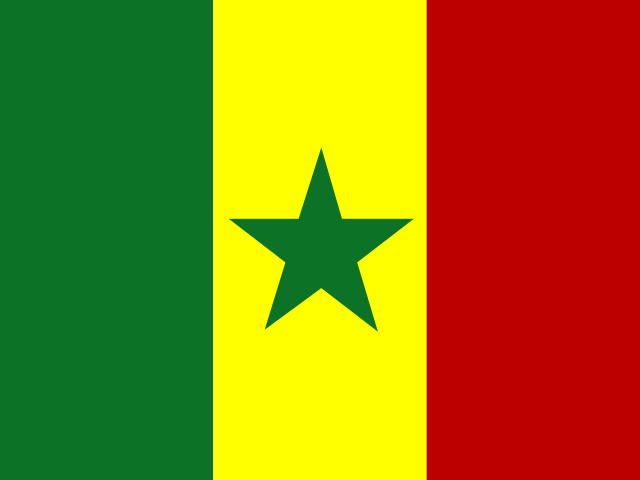
Senegal Cross-Border Guide to Business Investment in Africa Guide

Date posted:
05/10/2023
Last update:
05/10/2023

What type(s) of legal entity(ies) can a foreign investor set up in your country?

Under the OHADA (Organisation for the Harmonisation of Business Law in Africa) A foreign investor can set up several legal entities in Senegal, depending on the nature of the targeted activities. The most common business forms are:

  • Sole Proprietorship which is an economic unit involving the use of human and material resources for production or distribution, based on a pre-established organization.
  • The Public Limited Company (SA) is a company in which the shareholders are liable for the company's debts only up to the amount of their contributions, and whose shareholders' rights are represented by shares. The Public Limited Companies are generally used for large-scale projects. The mode of administration is determined by the articles of association, which choose between: Public Limited Company with Board of Directors and Public Limited Company with Managing Director.
  • A Limited Liability Company (SARL) is a company in which the partners are only liable for the company's debts up to the amount of their contributions, and whose rights are represented by shares.
  • A Simplified Joint-Stock Company, is a company set up by one or more partners, whose bylaws freely provide for the organization and operation of the company, subject to the mandatory rules of the Uniform Act on Commercial Companies and Economic Interest Groups (Uniform Act on Business Companies and General Interest Group (GIE).
  • General Partnership is a company in which all partners are merchants and are jointly and severally liable for the company's debts.
  • A Limited Partnership is a company in which one or more partners who are jointly and severally liable for the company's debts, known as "associés en commandite", coexist with one or more partners liable for the company's debts up to the limit of their contributions, known as "limited partners”, and whose capital is divided into company shares.

It is however, for advisable for foreign investors to set up Public Limited Company or a Limited Liability Company.

What is the principal legislation that governs the various legal entities that an investor can set up in your country?

  • These forms of Company are governed by the Uniform Act pertaining to the Commercial Companies Act and Genega Interest Group of January 30, 2014,
  • The Uniform Act on General Commercial Law of December 15, 2010

What is the process of registering each of the proposed entities in your country, and how long does it take?

To register a company under Senegalese law, the below procedure shall be followed:

  • Application to set up a company
  • Signature of articles of association before a notary
  • Collection of registration documents (1)
  • Obtaining registration documents

The institutions you need to visit are as follows:

  • Notary (x 3)
  • Investment and Major Works Promotion Agency (APIX) (x 2)
  • Legal notice
  • Bank

The documents required to register a company are:

  • Application form for registration in the Trade and Personal Property Credit Register
  • Tax existence application form
  • Declaration of honor
  • Notarized declaration of conformity
  • Authenticated articles of association
  • Register of deposited deeds
  • National identity card (x 2)
  • Receipt of deposit (x 2)
  • Certificate of registration (x 2)
  • Legal notice
  • Telephone bill
  • Amount of share capital
  • Tax stamp for commercial registration certificate
  • Tax stamp for NINEA registration notice

NB: All the above procedures can be carried out by the firm.

Are there any minimum share capital requirements?

For the Public Limited Company, the minimum share capital is FCFA 10,000,000.

For Limited Liability Companies, the minimum share capital is FCFA 1,000,000 FCFA. However, with the recent amendment, this minimum capital requirement for Limited Liability Company has been abolished. Henceforth, any interested party may set up his or her own company without the minimum share capital requirement.

For other companies, the law sets neither a minimum nor a maximum.

Are there any exchange control rules governing the flow of funds into and out of your country?

Exchange control rules are set out in regulation n°09/2002/ CM/WAEMU of September 26, 2022, relating to the freedom of capital transfers within WAEMU member states. This regulation sets out the conditions and procedures applicable to capital transfers between WAEMU member states and between these states and third countries.

Is there a requirement to have local (nationals) as directors? If so, how many?

Senegal has no specific legal requirement for a certain number of locals (Senegalese nationals) to be directors of companies incorporated in Senegal.

Is there any kind of legislation that requires specific demographics for the various legal entities or establishes a quota system (whether gender, ethnicity, race, disability, etc.)?

There is no legislation specifically obliging legal entities to comply with specific quotas based on demographic criteria such as gender, ethnic origin, or disability.

Are there any periodical statutory reports that the various legal entities would need to file?

Periodic statutory reports must be filed with the clerk of the Commercial Court in which the company is registered. The reports are as follows:

  • Annual financial statements
  • Annual reports
  • Tax returns
  • Value-added tax (VAT) declarations
  • Employee reports
  • Commercial and customs declarations

What are the key labour laws and regulations in your country, that would affect a foreign investor?

  • Law n°97-17 of December 1, 1997, on the Labor Code.
  • Decree no. 2006-1256 of November 15, 2006, setting out employers' obligations in terms of workplace safety.
  • Decree no. 94-244 of March 7, 1994, setting out the organization and operation of workplace health and safety committees.
  • National Interprofessional Collective convention of December 30th, 2019

What are the types of work permits foreign investors and employees need to obtain and what is the process involved in obtaining them?

There are several types of visas that will allow foreign nationals to enter Senegal. People planning to work in Senegal will need a work permit to do so. The most common types of work permit in Senegal are:

  • Local rental work permit
  • Assignment work permit

Applicants should contact the Senegalese prime minister for a full list of the documents they will need to apply for a work permit. These documents are generally required:

  • A complete application form addressed to the prime minister
  • A birth certificate
  • Three recent passport photos
  • A valid passport
  • A recent medical certificate
  • A police certificate from the applicant's country, obtained within the last three months
  • Work contract
  • Proof that the future employer is registered in Senegal
  • NB: This procedure will be highly facilitated by the intervention of Firm

What are the legal issues associated with foreign ownership of land?

In Senegal, two land tenure systems co-exist to administer property rights: the registration system and the national domain system. All land within the national territory is subject to these two systems in terms of management and administration. There is a constitutional prohibition on the creation of land ownership rights in favor of foreigners. Similarly, the signing of leases of more than 50 years is prohibited.

Which bilateral and multilateral treaties is your country a party to that help foster business?

  • Treaty signed between Senegal and Canada in 1962.
  • Economic Partnership Agreement (EPA) between the European Union and West Africa (Senegal).
  • African Continental Free Trade Agreement
  • United Nations Convention on the International Sale of Goods.
  • Economic Community of West African States (ECOWAS) Trade Liberalization Scheme (ETLS) - the ETLS is a regional trade agreement designed to promote intra-regional trade and investment between ECOWAS member countries.
  • World Trade Organization (WTO) agreements - Senegal is a member of the WTO and is party to various agreements that promote international trade.

Senegal is party to various agreements that promote international trade and investment

What are the government policies and incentives that are available to encourage investment in your country?

In Senegal, investment is supported by an attractive incentive policy based on regularly updated legal, tax and customs provisions. Tax relief measures, guarantees and advantages are granted to investors through the new investment code, the export processing zone, and the BOT law. A modern one-stop shop centralizes, facilitates, and accelerates administrative formalities. Senegal is also among eligible Sub-Saharan African Countries in AGOA which provides said with duty-free access to the U.S. market for over 1,800 products.

What are the key tax implications associated with opening and running the various legal entities in your country?

Investing in Senegal is an excellent choice, especially if you're looking to invest in an area with flexible tax rules. Senegal has adopted an Investment Code designed to stimulate investment through tax reductions and exemptions. These include:

  • VAT exemption for 3 years
  • Exemption from payment of customs duties
  • Tax credits of up to 40%.

What are the key Competition Laws in your country associated with opening the various legal entities by a foreign investor?

The law on prices, competition and economic litigation is Law N°94-63 of August 22, 1994. The purpose of this law is to regulate prices and promote competition in the Senegalese economy. It also aims to protect consumers against anti-competitive practices and to settle economic disputes.

Does your jurisdiction recognize alternative dispute resolution mechanisms and are local or international arbitral awards recognized and enforceable and if so, how?

Senegal recognizes alternative dispute resolution mechanisms. The country is a signatory to the New York Convention of June 10, 1958, on the Recognition and Enforcement of Foreign Arbitral Awards. This means that foreign arbitral awards can be recognized and enforced by Senegalese courts.

Are there any key laws aimed at protecting investors who wish to invest in your country?

Senegal has promulgated Law N°2004-06 of February 06, 20044 on the Investment Code. This law stipulates that individuals or legal entities are to be treated in the same way as Senegalese legal entities or individuals.

What is the current state of the investment climate in your country?

Senegal has signed several Investment Protection and Promotion Agreements (APPI) with partner countries around the world. In the context of globalization, these agreements improve the legal security of investments. They provide for the free repatriation of investment capital and returns. Senegal is fully committed to improving its business climate to promote investment and private-sector-led economic growth.

What are the investment opportunities available in your country for foreign investors? Identify the most viable industries or sectors in your country for investing.

Senegal has taken steps to improve the business climate and boost investment in the country's private sector. Reforms have also been launched to make the economy more competitive.

Here are a few promising sectors that offer the greatest chances of profitability for foreign investors in Senegal:

  • Real estate
  • Agriculture
  • Mining
  • Tourism
  • Agribusiness
  • Infrastructure
  • Oil and gas

What is the state of infrastructure in your country, and how will it affect foreign investment?

In recent years, Senegal has made significant progress in infrastructure, particularly in the road and port sectors, but also in the energy sector.

What are the risks associated with investing in your country, and how can they be mitigated?

The risks associated with investing in Senegal include economic vulnerability, low business diversity, underdeveloped infrastructure, political and security concerns, regulatory challenges, and corruption.

To mitigate these risks, investors should exercise due diligence, seek out local partners with a good track record, understand Senegal's business culture and obtain legal advice.

Disclaimer: This guide contains summaries of general principles of law. It is not a substitute for specific legal advice and should not be relied upon in relation to the application of the law or subject matter covered.