TerraLex Cross-Border Guide to Cross-Border Guide to Business Investment in Africa

TerraLex is pleased to announce its recent digital publication of a Cross-Border Guide to Business Investment in Africa. Africa’s emerging countries form an integral part of any successful global business strategy and offer tremendous growth opportunities for multinational companies and global entrepreneurs alike. The following guide provides important information businesses need to know while considering their investment into the region.

How to Use: You can use the tools below to create bespoke reports for the jurisdiction(s) and topic(s) covered. Click into single jurisdiction for one location or use the compare tool to compare multiple jurisdictions. Select the jurisdictions and topics of interest to create your unique report. You also have the option to print or download using the ellipsis button in the top right corner.

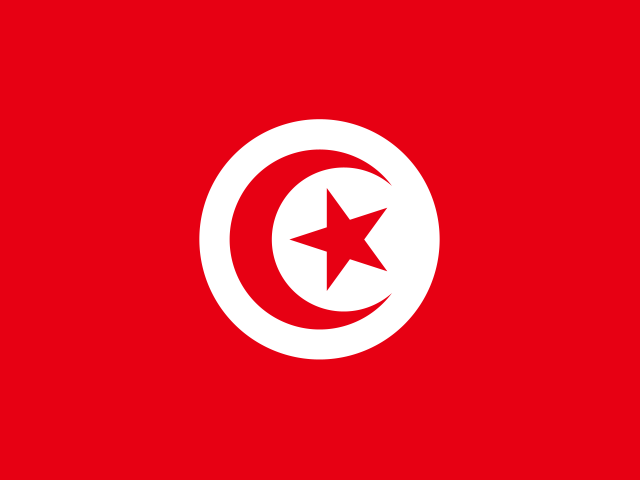
Tunisia Cross-Border Guide to Business Investment in Africa Guide

Date posted:
05/10/2023
Last update:
05/10/2023

What type(s) of legal entity(ies) can a foreign investor set up in your country?

Investors generally should opt for the incorporation of either a Limited Liability Company (LLC) also known as “société à responsabilité limitée” or a one-person LLC “société unipersonnelle à responsabilité limitée” or a joint stock company (JSC)/ “société anonyme”, being noted that the société anonyme is the form to which founders generally opt for large corporations with many investors. The société à responsibilité limitée or société unipersonnelle à responsabilité limitée is the most common and suitable form especially in the case of a Tunisian subsidiary fully owned by a foreign company.

What is the principal legislation that governs the various legal entities that an investor can set up in your country?

  • The Commercial Companies Code as enacted by law n° 2000–93 of 3 november 2000. It provides for the constitution, management, dissolution of companies as well as business reorganization procedures. The code sets forth corporate governance rules for the different types of companies.
  • Law No. 2018-52 of October 29, 2018, relating to the National Enterprises Register (“Registre National des Entreprises”). It creates a centralized digital platform setting forth incorporation, modification, and dissolution procedures.

What is the process of registering each of the proposed entities in your country, and how long does it take?

The setting up process of service or industrial companies shall occur at the one-stop service of the Agency for the Promotion of Industry and Innovation/ “Agence de Promotion de l’Industrie et de l’Innovation” (the “APII”) which is the Investment Center dedicated to the carrying out of industrial and service investments.

The APII’s one-stop service is the administrative center for legal formalities that brings together in one place, the different steps required for the constitution of an investment file and the creation of NewCos.

As an indicative timeframe, the incorporation process of a new company shall last between 10 and 15 days as from the submission of the file to the APII desk for LLCs and 20 to 30 days as from the submission of the file to the APII desk for JSCs.

Are there any minimum share capital requirements?

  • As to LLC and One-person LLC: The law does not establish a minimum share capital amount. Such amount is freely fixed by the shareholders in the articles of association. The share capital is divided into shares with equal nominal value.
  • As to JSC: The minimum share capital is 5,000 TND for non-listed companies and 50,000 TND for listed companies. The share capital must be divided into shares whose nominal amount cannot be less than five (5 TND) Tunisian Dinars.

Are there any exchange control rules governing the flow of funds into and out of your country?

Yes. Foreign exchange regulations are based in Tunisia on the Foreign Exchange Code as enacted by law n°76-18 as of January 21, 1976, as subsequently amended together with its enforcement texts (the “FEC”).

The general principle set forth under section 1 of the FEC is that (i) transfers of the proceeds resulting from the winding-up or liquidation of a capital initially invested through an import of foreign currency and (ii) transfers relating to current transactions are free.

Circular n°2016-09 of the CBT dated 30 December 2016 provides a list of the transfers that are considered as current transactions along with the conditions for carrying out such transfer. Any transaction or commitment which is not mentioned in the aforementioned list and of which a transfer of funds arises or may arise is submitted to prior authorization of the Central Bank of Tunisia.

Is there a requirement to have local (nationals) as directors? If so, how many?

  • As to LLCs and One-Person LLCs: The company is managed by one or several director(s) (individuals). The Director (“géran”t) is not required to be resident except for certain activities (such as companies acting in the retail sector). In addition, the legal representative of a company operating in certain type of activities (such as a call center acting on the local market) shall be a Tunisian national as per the requirement of the applicable terms and specifications.

  • As to JSCs: The management of a JSC is the responsibility of a board of directors appointed by the shareholders. The board directors shall be made of 3 to 12 members who could be either individuals or legal entities. The Board may choose two kinds of management structure:

    • Appointment of a Chairman (PDG) who will be the legal representative of the company.
    • Appointment of a Chairman of the board (Président du Conseil) and a Managing director (Directeur Général). The Chaiman or the general manager is not required to be national or resident. However, if the company operates in certain regulated activities (such as a local call center, the legal representative may be required to be Tunisian national. In addition, JSCs operating in the retail sector must have a chairman that is Tunisian national. In case of dissociation between the functions of Chairman of the board of directors and those of Managing Director (Directeur Général), the Managing Director must have the status of resident within the meaning of the exchange control regulations in force.

Is there any kind of legislation that requires specific demographics for the various legal entities or establishes a quota system (whether gender, ethnicity, race, disability, etc.)?

No.

Are there any periodical statutory reports that the various legal entities would need to file?

  • Monthly declarations: Companies are required to file a declaration that includes all amounts relating to withholding tax (including VAT, professional tax, etc.) no later than the 28th of each month for withholding taxes made the previous month.
  • Quarterly declarations: These declarations include:
    • Instalments which must be declared and paid during the first 28 days of the sixth, ninth and twelfth month following the closing date of the financial year; and
    • the social declaration which must be filed with the National Social Security Fund (CNSS) no later than the fifteenth day of the month following each semester.
  • Annual declarations: There are two types of annual tax declarations: (i) corporate tax declaration and (ii) employer declaration.

*The annual corporate tax declaration must be filed within a period not exceeding March 25 of each year on a provisional basis and June 25 on a definitive basis for companies subject to audit by a statutory advisor.

*The employer's statement consists of a summary table and a set of annexes. The table must contain the total deductions at source made during a year, in particular for salaries, rents, fees paid, etc. It must be filed within a period not exceeding April 28 of each year.

What are the key labour laws and regulations in your country, that would affect a foreign investor?

Employment relationship in Tunisia is governed by the Labour Code (promulgated by Law 66-27 of April 30th, 1966). Its provisions are applicable to all persons linked by an employment contract, whatever the conditions for performance, the nature and means of payment of the salary and the nature of the entity in which the work is performed may be.

Its main appendix, the Collective Labour Agreement (promulgated by order dated May 29th, 1973, and modified by three endorsements in 1985, 1993 and 2004), provides an outline for collective labour agreements in each sector of the Tunisian economy.

What are the types of work permits foreign investors and employees need to obtain and what is the process involved in obtaining them?

The employment of foreigners is governed by the provisions of Articles 258 to 271 of the Labour Code. A foreigner cannot be hired for a job if a Tunisian national has equivalent qualifications.

Pursuant to Article 258 of the Labour Code, any employer wishing to hire a foreign employee must obtain an authorisation from the Ministry of Employment. The foreign employee, to be compliant with law, must obtain a registration card on which is specifically mentioned his ability to work in Tunisia and an employment contract endorsed by the Ministry of Employment.

Any employer hiring a foreign employee must declare him or her to the Ministry of Employment. This declaration must be done according to procedures defined by the Ministry of Employment and occur within 48 hours after recruitment is effective.

The employment contract concluded with the foreign employee and stamped by the Ministry of Employment is issued for a period of 1 year, renewable only once. However, pursuant to the provisions of Article 258-2 of the Labour Code, this contract may be renewed more than once for foreigners working within their company on certain development projects in Tunisia.

Foreigners having the quality of corporate officer of a company (manager or co-manager in respect of a limited liability company and general manager or chairman of the board in respect of a joint stock corporation) may be recruited on the basis of a certificate of non- submission to the visa of the employment contract.

In addition, the foreign executive staff of a company may be recruited, on the basis of a certificate of non-submission to the visa of the employment contract, up to 30% of the total number of the company’s executives until the end of the 3rd year as from the date of incorporation of the company or the date of entry into effective activity at the choice of the company. This rate is reduced to 10% as from the fourth year. In any case, four executives may be recruited as foreigners by the company.

Once the above rates or limits are reached, the company remains subject, as regards the recruitment of foreign managers, to an authorization issued by the Ministry of Employment in accordance with the provisions of Articles 258 et subsequent of the Labour Code.


What are the legal issues associated with foreign ownership of land?

Foreign investors are entitled to own any type of land in Tunisia. However, pursuant to the provisions of Article 1st of Law n° 69-56 and the provisions of Law n° 97-33 reforming agricultural properties, foreign companies, as well as Tunisian companies which share capital is partially owned by foreigners cannot own rural agricultural properties.

In addition, pursuant to the provisions of Decree dated June 4th, 1957, relating to real estate operations, any deed of sale and purchase involving a foreigner (corporate body or individual) requires the prior authorisation of the Governor. Such an authorization being a condition of legal validity of the transaction, failure of which the related sale/purchase contract is null and void.

Which bilateral and multilateral treaties is your country a party to that help foster business?

  • Bilateral Investment Agreements
  • Bilateral double taxation Agreements
  • European Free Trade Association Treaty
  • COMESA Investment agreement

What are the government policies and incentives that are available to encourage investment in your country?

  • Tax exemptions/ incentives
  • Economic Activity Zones

What are the key tax implications associated with opening and running the various legal entities in your country?

The general Corporate Income Tax rate is 15%. However, specific rates are foreseen for specific sectors of activity (e.g.: 10 % for Companies carrying out craft activities, agricultural and fishing activities, and fitting out fishing boats, 35 % for banks and financial institutions).

What are the key Competition Laws in your country associated with opening the various legal entities by a foreign investor?

Law No. 2015-36 of September 15, 2015, on Reorganization of Competition and Prices.

Does your jurisdiction recognize alternative dispute resolution mechanisms and are local or international arbitral awards recognized and enforceable and if so, how?

Both foreign judgements and arbitration awards can be recognized in Tunisia. It is possible to opt for arbitration rather than court jurisdictions. The recognition of the foreign judgment or arbitral award requires a final enforceable decision (i.e., not subject to an appeal).

Are there any key laws aimed at protecting investors who wish to invest in your country?

  • Investment Law n°2016-71 of 30 September 2016
  • Bilateral Investment Treaties

What is the current state of the investment climate in your country?

Tunisia has a positive investment climate. Tunisia’s strengths include its proximity to Europe and given its geographical location it is considered as one of the gates to Africa.

What are the investment opportunities available in your country for foreign investors? Identify the most viable industries or sectors in your country for investing.

Tunisia offers investment opportunities in multiple growth sectors, such as aeronautics, automotive, ICT, pharmaceutical industry, and renewable energy.

What is the state of infrastructure in your country, and how will it affect foreign investment?

Tunisia’s has made significant investments in infrastructure, which has contributed to economic growth. While there is room for improving Tunisia’s utility infrastructure and connectivity to the poorer interior regions, the local infrastructure ranks strongly by regional standards.

To reverse the decline of recent years, and in turn improve maintenance, capacity and efficiency, the country is rolling out several initiatives to boost connectivity, in collaboration with external donors and private sector partners. Among the new projects mooted are a new Africa-focused freight carrier, highway upgrades and a pending open skies agreement

What are the risks associated with investing in your country, and how can they be mitigated?

Risks associated with investing in Tunisia include political instability, regulatory challenges, a relatively conservative economic system, state monopolies and bureaucracy. To mitigate these factors, one needs to conduct due diligence when investing in the country, keeping up to date with local news to keep informed on the latest economic and political developments, and seek advice from local experts and partners.

Disclaimer: This guide contains summaries of general principles of law. It is not a substitute for specific legal advice and should not be relied upon in relation to the application of the law or subject matter covered.