TerraLex Cross-Border Guide to Cross-Border Guide to Mining Rights

Welcome to the Terralex cross-border guide to mining rights

We are proud to share this Cross-Border Guide to Mining Rights. Each of the contributors to the guide has provided information and background as to the likely application of their respective regimes' mining activity.

How to Use: You can use the tools below to create bespoke reports for the jurisdiction(s) and topic(s) covered. Click into single jurisdiction for one location or use the compare tool to compare multiple jurisdictions. Select the jurisdictions and topics of interest to create your unique report. You also have the option to print or download using the ellipsis button in the top right corner.

Tanzania Cross-Border Guide to Mining Rights Guide

Date posted:
26/09/2023
Last update:
26/09/2023

Regulatory framework

Provide a brief summary of the regulatory framework surrounding the mining industry in this jurisdiction.

There are several laws that govern the mining industry in Tanzania, however, the cardinal rule is found under Section 22 of the Land Act [Cap.113] of 2019 which states that, all minerals discovered in Tanzania are owned by the government by default, unless specified otherwise through mineral rights. The principal laws and regulations are as follows:

  1. The Constitution of the United Republic of Tanzania of 1977;
  2. The Land Act [Cap.114 RE 2019];
  3. The Village Land Act [Cap 112 RE 2019]
  4. The Land Registration Act [Cap 334 RE 2019]
  5. The Mining Act [Cap.123 R.E. 2019];
  6. The National Environmental Act [Cap.191] of 2004;
  7. The Investment Act [Cap 38 of 2023]
  8. The Mining (Mineral Rights) Regulations, 2018;
  9. The Mining (Mineral Rights) (Revocation of the First Schedule) Regulations, 2018;
  10. The Mining (Local Content) Regulations, 2018
  11. The Strategic Environmental Assessment Regulations , 2008;
  12. The Environmental Management (Water Quality Standards) Regulations, 2007;
  13. The Environmental (Soil Quality Standards) Regulations, 2007;
  14. The Environmental Impact Assessment and Audit Regulations, 2005.

What are the main authorities involved in regulating the mining industry in this jurisdiction?

In Tanzania, the Ministry of Minerals oversees the mining industry through the Mining Commission and works alongside the Tanzania Investment Centre (TIC) and National Environmental Council to enforce regulations and maintain standards.

Exploration, exploitation, and production rights

What is the process for authorizing or obtaining a concession for mining activities?

In an effort to promote and facilitate investments in Tanzania, the government established the Tanzania Investment Center (TIC). The center provides access to both fiscal and non-fiscal incentives to investments in Tanzania. TIC provides a certificate of incentives which is obtained through an application.

Briefly describe the details required and process for an application for mining.

Before starting operations in the mining industry, there are several procedures that need to be carried out. These include: 1. The registration and incorporation of the company; 2. Registration to the Mining Cadastre Portal; 3. Conducting feasibility studies to assess the viability of the proposed mining site; 4. Obtaining the necessary permits and licenses from regulatory bodies, ensuring compliance with environmental and safety regulations; 5. Obtain Certificate of Incentive from TIC where applicable; and 6. Securing financing for the project.

It is important to carefully plan and execute all of these steps to ensure a successful and sustainable mining operation.

What are the requirements for mining exploration?

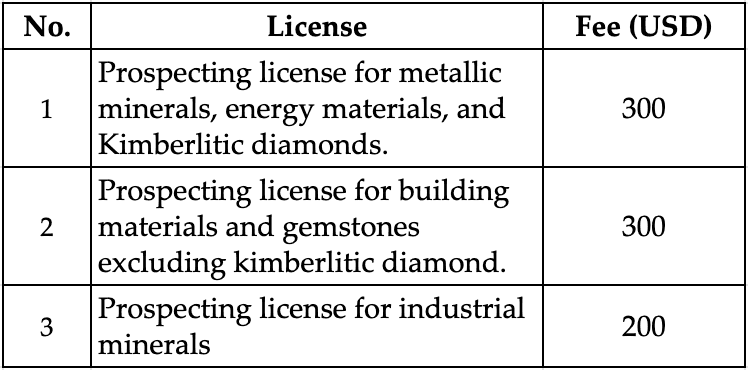
To start the application process for a prospecting license under the Mining (Mineral Rights) Regulations of 2018, it is necessary to fill out application form MRF 1. The fee for the license will vary depending on the specific minerals that will be explored.

An application for a prospecting license can be made for the following groups of minerals:

  1. Metallic minerals;
  2. Energy minerals;
  3. Gemstone excluding kimberlitic diamond;
  4. Kimberlitic diamond;
  5. Industrial minerals; or
  6. Building materials.

The table below illustrates the fees from the Mining (Mineral Rights) (Revocation of the First Schedule) Regulations of 2018:

tanzania-mg-1.pngtanzania-mg-1.png

What are the requirements for mining exploitation/production?

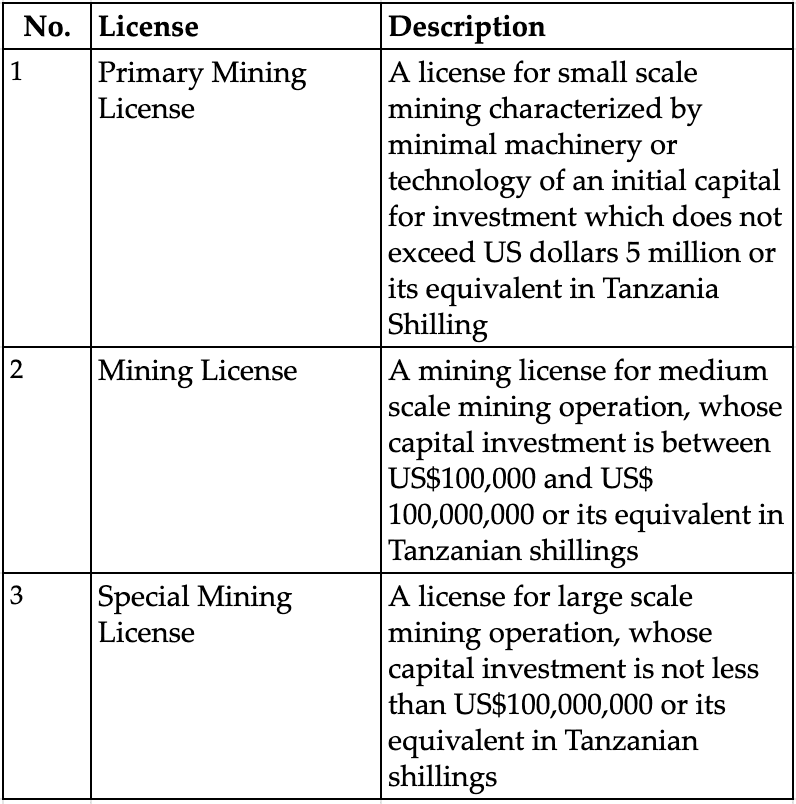
It is crucial to distinguish between the various types of mining licenses before starting exploitation or production. It should be noted that for mining licenses and special mining licenses the Government shall have a 16% ownership in free carried interest shares in the capital of a mining company depending on the type of minerals and the level of investment. The table below categorizes and explains the three mining licenses: tanzania-mg-2.pngtanzania-mg-2.png

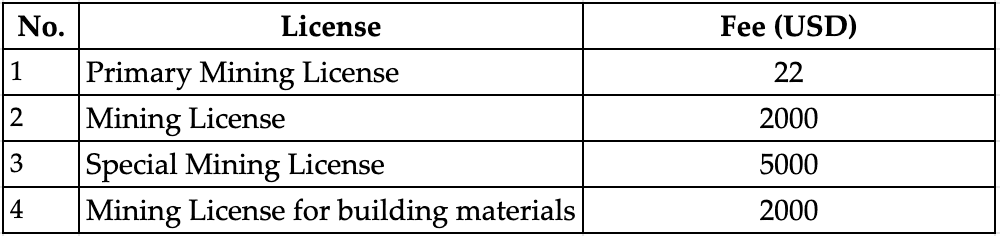
In order to apply for a mining license under the Mining (Mineral Rights) Regulations of 2018, you must complete one of the following application forms: MRF 6 for a Primary Mining License, MRF 13 for a Mining License, or MRF 14 for a Special Mining License.

The fee for each license will depend on the size of the business as prescribed in the Mining (Mineral Rights) (Revocation of the First Schedule) Regulations of 2018: tanzania-mg-3.pngtanzania-mg-3.png

There are also three categories of production licenses, as shown in the table below: tanzania-mg-4.pngtanzania-mg-4.png

Briefly describe the compensation for exploitation/production of mineral resources, if any.

As per Article 22(2) of the Constitution of the United Republic of Tanzania, it is unlawful for anyone to have their property confiscated for nationalization or any other reason without proper legal authorization, which must include just and reasonable compensation.

In addition, Tanzania's National Environmental Act upholds rules that compensate locals affected by mining activities under Section 5(2)(f) and the "polluter pays" principle under Section 2.

What is the process for the transfer of mining rights?

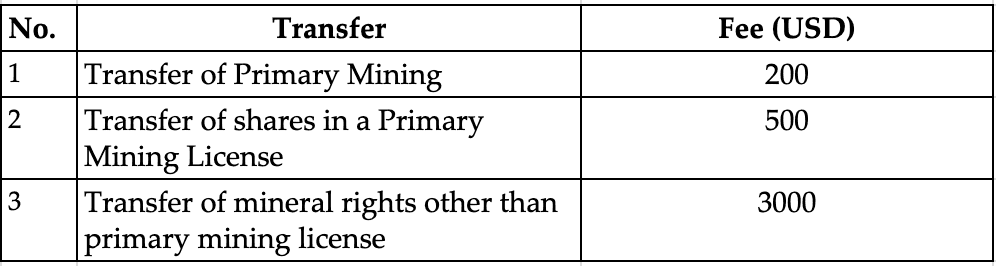
A mineral right holder can transfer or assign the rights by making an application for registration of transfer/assignment of mineral rights. There are three categories of mineral rights transfer, each with its own fees listed in the table below: tanzania-mg-5.pngtanzania-mg-5.png

The transfer of mineral rights requires filling out form No. MRF.13

Environmental and safety concerns

How is mining in specially protected areas addressed?

According to Section 161 of the National Environmental Act, mining is allowed in protected areas but it must be closely monitored by the National Environmental Council. The aim is to limit or prevent any detrimental effects on the area. The Ministry of Minerals will work with the National Environmental Council to conduct a Strategic Environmental Impact Assessment, and the results will be presented to the Ministry for approval or denial of the mining activity.

What are the general considerations regarding mining and environmental matters?

Section 171 of the National Environmental Act mandates the Mining Commission to submit the following to the National Environmental Council: 1. Environmental matters contained in any development agreements that are required to be made between the Government and the holder of a mineral right or an applicant for a mineral right; 2. Environmental studies and assessments made by appropriate experts or consultants which are required to accompany applications for retention licenses showing any impact on the environment and the manner the applicant proposes to eliminate or minimize any adverse effects on the environment; 3. Any such terms and conditions on protection and preservation of the environment which may be implied into mineral retention licenses or mineral development agreements; 4. Such environmental management plans, or proposals for prevention of pollution, or plans for treatment of waste, or plans for reclamation of land and water resources, or plans for minimizing the adverse effects on the environment resulting from mining operations, that may be prepared by applicants for special mining licenses. 5. Environmental impact assessments on any proposed mining operations commissioned by the applicants for special mining licenses to the Minister responsible for minerals; 6. Environmental management plans appended to the special mining licenses; and 7. Environmental management plans in respect of mining operations prepared by applicants seeking to renew special mining licenses any such refusal to renew on account of impact on the environment.

What, if any, environmental licensing is required for mining projects?

What, if any, safety policies does your jurisdiction impose regarding dams?

According to Section 95 of the Mining Act, the holder of mineral rights cannot enter certain areas without written consent from the responsible Minister. This includes any land within 200 meters of any building, reservoir, or dam that is owned by the Government.

Mining developments

What do you consider to be the top recent mining development(s) in this jurisdiction?

To promote local participation and beneficiation, Tanzania has put in place laws and regulations that ensure transparency and accountability in the mining industry. The country also seeks to encourage joint ventures with foreign investors like the Twiga Minerals Corporation Limited in partnership with Barrick Gold Corporation to enhance cooperation and mutual benefits.

Graphite mining in Tanzania has been gaining momentum in recent years. The country has an estimated graphite reserve of 17 million tons, which accounts for about 5% of the world’s total graphite reserves. The most significant graphite deposits are located in the central and southeast regions of Tanzania, and the country is home to several active graphite projects, including Bagamoyo, Bunyu, Chilalo, Epanko, Nachu, and Lindi Jumbo. One of the notable developments in graphite mining, the Chilalo Graphite Project, which is being developed by Evolution Energy Minerals, an Australian mining company which in April 2023 entered into a framework agreement with the Government of Tanzania. The project is located in southeast Tanzania and hosts a high-grade mineral resource. The project is expected to produce approximately 60,000 tons per year of graphite concentrate.

Tanzania has significant potential for rare earth element (REE) deposits, and the country has a number of REE projects in various stages of development. The most advanced project is the Ngualla Rare Earth Project. The project is located near the Ngwala Village, approximately 150 km from the City of Mbeya in the Songwe Region, and on the edge of the East African Rift Valley. It is considered one of the largest, highest-grade, and lowest-cost Neodymium Praseodymium (NdPr) rare earth deposits in the world. The Ngualla Project is expected to have a mine, mill, concentrator, community projects, and associated infrastructure. The project will undertake significant beneficiation and value-adding in Tanzania. The high-grade rare earth concentrate will be initially sold as a standalone product while exploring downstream integration opportunities in collaboration with the Government of Tanzania which has already entered into agreement with three mining companies: Evolution Energy Minerals, Ecograf Ltd and Peak Rare Earths.

Other notable developments include a report by Mining Weekly that Volt Resources intends to progress to Stage 2 of the Bunyu graphite project later this decade to leverage the platform established by Stage 1. In December 2021, Tanzania signed new framework agreements with Australian companies Strandline Resources, Black Rock Mining and OreCorp, which was awarded a special mining license for its Nyanzaga gold project, reflecting over $100 million in committed capex.


What do you believe will be the top mining developments in the next few years in this jurisdiction?

Tanzania is rich in minerals and natural resources, which have helped to create a flourishing mining industry that plays a crucial role in driving the country's economic growth and development. The mining sector is responsible for exploring and producing a variety of minerals, including gold, diamonds, coal, natural gas, rare earth minerals, and critical minerals, which are in high demand around the world.

With its potential to become the largest gold producer on the African continent, Tanzania is currently the sole producer of the rare gemstone, tanzanite.

The mining sector in Tanzania is an excellent example of how natural resources can be utilized for sustainable development and prosperity. The industry is poised to continue growing in the coming years, with significant diversification into the mining of nickel, uranium, and coal. This makes Tanzania's mining industry an attractive prospect for investors.

Disclaimer: This guide contains summaries of general principles of law. It is not a substitute for specific legal advice and should not be relied upon in relation to the application of the law or subject matter covered.