TerraLex Cross-Border Guide to Cross-Border Labor & Employment Guidance
Welcome to the TerraLex cross-border labor & employment guide
We are pleased to present the TerraLex Cross-Border Labor & Employment guide. This guide aims to provide you with high-level information across a number of jurisdictions for your most valuable asset - your employees. This is a valuable resource to general counsel, chief legal officers, human resources and talent executives, and anyone on your team who manages people within your organization.
How to Use:You can use the tools below to create bespoke reports for the jurisdiction(s) and topic(s) covered. Click into single jurisdiction for one location or use the compare tool to compare multiple jurisdictions. Select the jurisdictions and topics of interest to create your unique report. You also have the option to print or download using the ellipsis button in the top right corner.
Australia Cross-Border Labor & Employment Guidance Guide
Australia, as a federation of former British colonies, has a legal system derived from the English common law. While common law employment principles remain relevant today, the bulk of Australia's employment law is derived from statutes made at the Commonwealth (national) level. In this chapter we cover the key issues to be aware of if you are thinking of engaging individuals to work as employees or contractors in Australia.
The primary source of employment rights in Australia is the national Fair Work Act 2009 (FW Act). This legislation is administered by the Fair Work Commission (FWC). There are also laws specific to some States and Territories within Australia, so employers must be mindful of the jurisdiction they are operating in.
Employment status
Most Australian workers are engaged by companies as employees; however, it is also common for workers to be engaged as "independent contractors".
A worker's rights will vary depending on which of these categories he or she falls within. Generally, employees have much stronger rights than independent contractors, such as rights to minimum wage rates, superannuation (some contractors are also entitled to superannuation), paid leave, redundancy payments and protection against unfair dismissal. For this reason, employers often prefer to engage a worker as an independent contractor; however, there are risks (including large financial penalties) associated with engaging a worker as an independent contractor under an arrangement that more closely resembles the law's concept of employment.
Immigration and hiring foreign nationals
Foreign workers in Australia are subject to extra regulation, namely they will require a visa to work in Australia. Additionally, employers in Australia need to be cognisant of Modern Slavery legislation and the significant penalties associated with worker exploitation in their supply chain. Australian employers must be vigilant in checking their employees' right to work in Australia. At a minimum, employers should check the visa label attached to an employees passport to ascertain their work rights.
Terms of employment
Employers in Australia are not required to enter into a written contract with their employees; however, the vast majority of Australian employees will be covered by some written allocation of rights, responsibilities, and risks. These include contracts at the individual level, "enterprise agreements" at the enterprise level, and "modern awards" at the industry and/or occupational level. Many awards require an employer to provide certain details of the employment in writing. Employers must also keep prescribed employee records relating to matters such as pay, overtime, leave, and superannuation contributions.
Almost all Australian employees are subject to ten minimum standards set out in the FW Act. These minimum standards are called the "National Employment Standards" and are often referred to as the "NES".
One of the NES requires employers to provide new employees with a written statement setting out certain information. Employers can face penalties for failing to comply with this requirement.
Wages
Most workers in Australia are entitled to be paid a national minimum wage. Employers who pay below the national minimum wage may be liable for large penalties. The national minimum wage is less for employees under the age of 21 and for some apprentice employees. The national minimum wage does not apply to independent contractors who are not deemed by law to be employees, although some independent contractors are regulated by some forms of minimum standards.
There are also minimum wages specific to particular industries. These are contained in modern awards and cannot be undercut by an enterprise or individual agreement.
The FWC has power to make orders for equal remuneration for men and women for work of equal or comparable value.
Collective agreements
As noted above, there are two main forms of collective employment arrangements in Australia that set minimum terms and conditions of employment for certain employees: enterprise agreements and industry and/or occupation-wide modern awards.
Modern awards are made by tribunals in consultation with stakeholder organisations and have statutory force. This means a term of an individual contract which breaches a modern award may be ineffective and expose the relevant employer to serious penalties.
Alternatively, employees working for a particular enterprise may collectively agree on their conditions with their employer in an enterprise agreement. For an enterprise agreement to be valid, the employees subject to it must be better off overall than they would be under the applicable modern award.
Pension and benefits
Australia operates a compulsory superannuation scheme, under which employers are required to contribute a minimum percentage of an employee's earnings into a stipulated superannuation fund for that employee's benefit.
These funds are privately run but highly regulated. An employee is entitled to nominate the fund into which its employer will make contributions. In the absence of a nomination, an employer can make deposits into its preferred fund or a modern award may stipulate a "default fund".
Alternatively, employees can manage their own superannuation funds. These are commonly referred to as self-managed super funds. Employees can access their superannuation once they reach a certain age.
The provision of other benefits (including health or medical benefits) is at the discretion of the employer.
Worker representation
In many industries, trade unions remain very prominent as representatives of their employee constituencies, at both the individual and collective bargaining levels. Australian employees' right to associate with (or not associate with) a trade union is protected. The FW Act prohibits the adverse treatment of an employee on the basis of his or her union membership (or lack of union membership).
The FW Act also protects employees' rights to be represented by an employee organisation during a period of collective bargaining.
Most employers proposing to terminate the employment of 15 or more employees for economic, technological, or structural reasons must inform the relevant trade union of their intention to do so.
Working time and holidays
Working hours are covered by the NES, which stipulates that an employee must not work more than 38 ordinary hours per week. However, this cap is subject to the exception of reasonable additional hours. In practice, most full-time employees in Australia work between 38 and 45 hours per week over five days.
Certain employees, such as parents with school age children, are permitted to request flexible working hours arrangements. Such requests can only be refused in writing and on reasonable grounds.
Modern awards and enterprise agreements typically provide for 30-60 minute rest periods for periods of work in excess of five consecutive hours. Awards can often limit the number of hours that can be worked within a defined period (for example, 9 hours in a 24 hour period).
Most full-time employees are entitled under the NES to four weeks' paid leave annually. This equates to 20 days of paid leave for an employee working five days per week.
The NES prescribe other paid leave entitlements, including 10 days' sick/carer's leave per year and two days' compassionate leave where a particular incident has occurred.
Protection against dismissal
In addition to any contractual rights which may be available to them, most Australian employees are protected against "unfair" dismissal. The FW Act provides that a person's dismissal will be deemed to be unfair if it is "harsh, unjust or unreasonable". Employers who fail to give employees appropriate warnings, fail to provide appropriate reasons for a dismissal, or opportunities to respond to such reasons may be exposed to an unfair dismissal claim from a dismissed employee. In addition, employers should follow any relevant procedures in awards, agreements, or company policies in dismissing an employee.
For an employee to be protected by the prohibition against unfair dismissal, he or she must earn under a specified remuneration amount (or be subject to an award or enterprise agreement) and have completed a minimum length of service.
An employee who has been dismissed due to a "genuine redundancy" will not be protected by unfair dismissal laws. This is discussed in more detail below.
Compensation for unfair dismissal is capped at six months' salary, although in some rare cases the employee can be reinstated in their employment and receive more than six months' compensation.
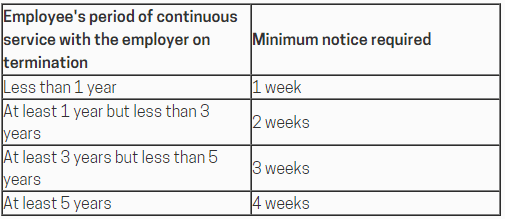
Employers are also subject to certain minimum termination notice periods, unless termination is due to serious misconduct. The minimum notice periods are set out in the following table.
(Employees over the age of 45 with at least two years' service are entitled to one additional week's notice.)
Employers can often comply with these notice requirements by paying employees in lieu of notice.
Redundancy and restructuring
Special conditions apply where an employee is dismissed due to a redundancy. The FW Act stipulates that a dismissal will be a case of genuine redundancy if: - the operational requirements of the employer's business mean the employer no longer requires the relevant job to be performed;
the employee has complied with any consultation obligations; and
the employee has reasonably (but unsuccessfully) considered redeploying the employee within the employer's broader enterprise.
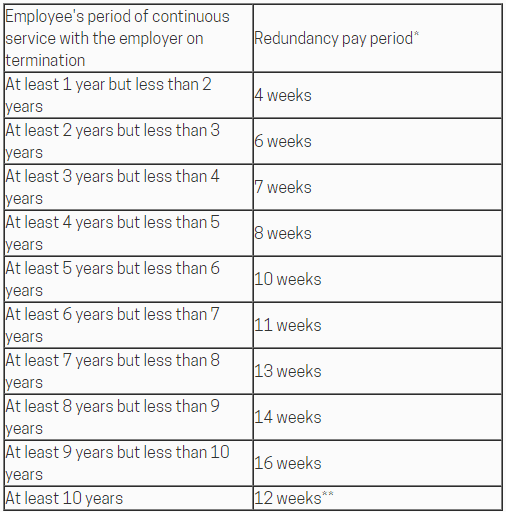
Where a termination is the result of a redundancy, an employee may be entitled to redundancy benefits in accordance with the NES. These benefits are in addition to the notice periods set out above. An employee's entitlement to severance payments will depend on the employee's length of continuous service. The minimum severance payments required by the NES are set out in the following table.
"Week" denotes the ordinary rate of pay for the relevant employee for one week. This excludes overtime, penalty rates and other special allowances.
** The redundancy payment value drops after 10 years as most employees are able to access long service leave payments after 10 years' employment.
Employees with less than 12 months of continuous service are not entitled to redundancy benefits.
Most employers with fewer than 15 employees are not required to pay redundancy benefits.
Buying or selling a business
In most instances of a business being transferred from one entity to another, it is likely that the FW Act's transfer of business provisions will apply.
A transfer of business within the meaning of the FW Act will generally occur where:
the employment of an employee of the old employer has terminated;
within three months after that termination, the employee becomes employed by the new employer;
the work the employee performs for the new employer is the same or substantially the same as the work the employee performed for the old employer; and
one of the following applies:
the new employer owns some or all of the assets of the old employer that relate to the employment; or
the two entities are associated; or
one entity outsources work to another employment provider or work that was previously outsourced to another employment provider is insourced.
Where transfer of business provisions apply, employment obligations relating to the old employer, such as enterprise agreements, may transfer to the new owner.
In some situations, a new business owner may take on the leave entitlements owed by the previous owner to its employees, such as long service leave. Where this is not the case, the seller of the business will be required to pay employees in lieu of their leave entitlements.
Resolution of employment disputes
Early resolution of disputes through negotiation is encouraged in most areas of Australian law. This is particularly the case in employment disputes. In many situations, a person with a complaint under the FW Act will need to bring proceedings in the FWC before they can access the court system. Depending on the nature of the complaint, the parties may be required to engage in mediation (facilitated by the FWC) before the matter can proceed to a hearing and determination.
If a matter does not resolve through mediation and the party bringing the complaint wishes to take the matter to hearing, the matter will be heard by the FWC (if agreed by the parties), the Federal Circuit Court or the Federal Court. Proceedings in the FWC tend to be less formal and less expensive than those held in a court.
There can be significant cost consequences for parties who do not engage reasonably in cooperative efforts to resolve disputes before they proceed to a hearing.
Other statutory rights
Australian employees may also be eligible for a number of other rights during employment, including paid or unpaid parental leave (including for parents who have recently adopted a child), paid carer's leave and long service leave, and certain rights to take unpaid leave, including unpaid leave for family and domestic violence.
Employment of children and young persons
The law regarding the employment of children and young persons varies depending on the jurisdiction within Australia. New South Wales, Queensland, and Victoria each have legislation regulating the employment of children and young persons, generally establishing prohibitions against employing children in situations like during school hours, late at night, or in indecent circumstances. Additionally, Australia is a signatory to, and has ratified, the United Nations Convention on the Rights of the Child; however, the provisions of the Convention only form part of the law in Australia to the extent that they have been recognised as a 'relevant international instrument' under the Australian Human Rights Commission Act 1986 (Cth) and where referenced in federal anti-discrimination legislation.
Discrimination
Prospective and current employees are also protected against discrimination on certain bases, including age, disability, race, gender, sexual preference, social origin, nationality, political opinion, and trade union activity. There are a number of legislative schemes at both the state and national levels that prohibit discrimination. The level of compensation that can be awarded for prohibited discrimination can in some circumstances be unlimited.
Outsourcing and personnel supply
'Outsourcing' certain business operations or functions is common practice in Australia. As noted above in "Buying or selling a business", outsourcing (and 'insourcing') may amount to a transfer of business under the Fair Work Act 2009 Cth.
Personnel supply through "labour hire" or "on hire" businesses is also common in Australia. Standard modern award terms include the regulation of "on hire" employment relationships in the award's relevant industry or occupations. More recently, labour hire licensing legislation has been introduced in some States and the Australian Capital Territory to regulate labour hire businesses, typically by requiring them to seek and obtain a licence to operate that must be renewed regularly.
Employee rights protections
Under the FW Act, employees have certain 'workplace rights', such as the benefit of 'general protections' that preclude an employer from taking 'adverse action' against them to prevent them from or to punish them for exercising or preparing to exercise a 'workplace right'. Australian employers need to ensure that they comply with their obligations under the law, otherwise they risk an employee making a 'general protections' claim against them seeking monetary penalties, compensation and other remedies.
Other comments
Disclaimer: This guide contains summaries of general principles of law. It is not a substitute for specific legal advice and should not be relied upon in relation to the application of the law or subject matter covered.