

On discovering a data breach, which regulators or other government agencies should be notified?
There is no enforcement mechanism in place.
When a crisis hits your organisation, you need to take action quickly. What practical steps can you and your team take to minimize the impact on your business? What are your reporting requirements in the relevant jurisdiction(s)? What legislation applies there?
Our guide provides you with the answers to these questions in relation to key jurisdictions and it supports your understanding of the relevant local legal framework. It also provides high level practical guidance for those crucial first 72 hours, together with contact details of the local TerraLex firm for when you need specialist advice.
A crisis, by its nature, is both serious and unexpected and your response and actions within the first 72 hours will most likely define its impact on your organisation.
It is therefore important to have in place robust procedures that, if followed, will help minimize the adverse consequences.
The crisis checklist below includes next steps which are common across all jurisdictions. Please refer to the chapter for the relevant jurisdiction for more detailed guidance on your obligations in that country.
How to Use: You can use the tools below to create bespoke reports for the jurisdiction(s) and topic(s) covered. Click into single jurisdiction for one location or use the compare tool to compare multiple jurisdictions. Select the jurisdictions and topics of interest to create your unique report. You also have the option to print or download using the ellipsis button in the top right corner.
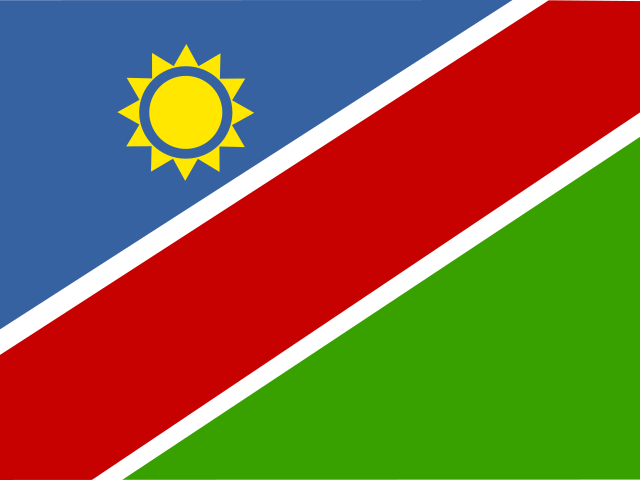
There is no enforcement mechanism in place.
There are no specific laws that regulate the manner in which personal data may be stored or transmitted online. But personal data is protected indirectly by the Namibian Constitution, in Article 13 of thereof.
The Namibian Competition Commission, as per the Competition Act 2 of 2003 (the “Act”).
According to section 35(4) of the Act, a person attending before the Commission is entitled to the same immunities and privileges as a witness before the High Court. Therefore, the same privilege would apply and thus, the organisation may refuse to permit the seizure based on legal professional privilege.
In Namibia, the agencies that have the power to conduct dawn raids on private sector companies are primarily the Namibian Police Force (NPF) and the Anti-Corruption Commission (ACC). The NPF is responsible for enforcing criminal law in Namibia, including investigating and prosecuting offenses related to economic crimes, while the ACC is tasked with investigating and preventing corruption.
The power of these agencies to undertake inspections is provided for by various pieces of legislation. The ACC derives its powers from the Anti-Corruption Act of 2003, which grants it the authority to conduct searches and seizures of documents and other items in the course of its investigations. Similarly, the NPF's power to conduct dawn raids is provided for by the Criminal Procedure Act of 1977, which outlines the procedures that law enforcement officers must follow when conducting searches and seizures.
It is worth noting that, in Namibia, as in most countries, dawn raids are a serious matter and can only be conducted under specific circumstances and with the appropriate legal authority.
Under the Whistelblowers Protection Act of 2017, an employee in Namibia who reports an alleged wrongdoing or malpractice, also known as a whistleblower, is entitled to certain protections. To be protected under the Act, the whistleblower must have a reasonable belief that the information they are disclosing relates to a criminal offense, a breach of legal obligation, a miscarriage of justice, a danger to health or safety, or the environment.
Once a disclosure has been made, the employer is prohibited from retaliating against the whistleblower by, for example, dismissing or disciplining them, or subjecting them to any form of victimization. The Act also protects the whistleblower's identity and prohibits the employer from disclosing it.
If a whistleblower believes that they have suffered any form of retaliation or victimization, they can bring a claim before the Labour Court within 90 days of the alleged retaliation or victimization. If the court finds that the whistleblower has been unfairly treated, it may order that the whistleblower be reinstated, compensated, or provided with any other form of relief that the court deems appropriate.
It is worth noting that the Act provides protection only to whistleblowers who make disclosures in good faith and who follow the procedures set out in the Act. Disclosures made for personal gain or with malicious intent are not protected under the Act.
In terms of subsections 39(2), 43(3) and 45(1) of the Whiste-blower Protection Act No 10 of 2017, whistleblower protection is granted from the date of the first receipt of the disclosure of corruption until the Commissioner of the Whistleblower Protection Office terminates it in terms of section 52 of the Act.
Section 45(1)(d) of the Whistle-blower Protection Act provides for protection in terms of the Witness Protection Act 2007.
Namibia has several laws and regulations in place to prevent and combat corruption namely: 1. Anti-Corruption Act, 2003 - This Act provides for the prevention, investigation, and punishment of corrupt practices and offences. It established the Anti-Corruption Commission, which is responsible for investigating and prosecuting corruption cases. 2. Prevention of Organised Crime Act, 2004 - This Act aims to prevent and combat organized crime, including corruption. It provides for the forfeiture of proceeds of crime and the establishment of a Financial Intelligence Centre to monitor financial transactions and detect money laundering. 3. Public Procurement Act, 2015 - This Act regulates the procurement of goods, services, and works by public entities and aims to ensure transparency and accountability in public procurement processes. 4. Financial Intelligence Act, 2012 - This Act establishes the Financial Intelligence Centre, which is responsible for detecting and preventing money laundering and terrorist financing. 5. Whistleblower Protection Act, 2017 - This Act provides protection to whistleblowers who disclose information about corrupt practices, malpractices, or other wrongdoing.
In addition to these laws, Namibia is a signatory to several international anti-corruption conventions and initiatives, including the United Nations Convention against Corruption, the African Union Convention on Preventing and Combating Corruption, and the Extractive Industries Transparency Initiative.
In general, anti-corruption legislation in Namibia has territorial jurisdiction and applies to corrupt activities that occur within the country. However, some aspects of Namibia's anti-corruption laws may have extra-territorial effect. For example, under the Prevention of Organised Crime Act of 2004, Namibian authorities can investigate and prosecute Namibians who commit corruption or other criminal activities outside of Namibia if those activities have a link to Namibia, such as where the proceeds of the crime are brought into or through Namibia.
Similarly, under the Anti-Corruption Act of 2003, Namibian authorities may cooperate with foreign authorities in investigating and prosecuting corruption cases that have a link to Namibia or involve Namibian citizens or entities. The Act also provides for the extradition of individuals suspected of committing corruption offenses to foreign countries.
It is important to note, however, that the extra-territorial application of Namibia's anti-corruption laws is subject to various legal and practical limitations, including the existence of extradition treaties, the availability of evidence, and the cooperation of foreign authorities.
The main enforcement bodies of anti-corruption in Namibia are the following: 1.Anti-Corruption Commission (ACC): The ACC is an independent body established under the Anti-Corruption Act of 2003. The Commission is responsible for investigating and prosecuting corruption offenses, conducting corruption prevention activities, and promoting public awareness about corruption. 2. Namibian Police Force (NPF): The NPF is responsible for enforcing criminal law in Namibia and plays a significant role in investigating and prosecuting corruption offenses, particularly those related to economic crimes. 3. Office of the Prosecutor-General: The Office of the Prosecutor-General is responsible for prosecuting criminal offenses in Namibia, including corruption offenses. The Prosecutor-General has the power to institute and conduct criminal proceedings against individuals suspected of committing corruption offenses. 4. Financial Intelligence Centre (FIC): The FIC is responsible for detecting and preventing money laundering and terrorist financing activities. It monitors financial transactions and reports suspicious transactions to law enforcement agencies, including those related to corruption. 5. Public Procurement Board (PPB): The PPB oversees public procurement processes in Namibia and is responsible for ensuring transparency and accountability in procurement activities. It has the power to investigate and prosecute corruption offenses related to public procurement.
In addition to these bodies, there are other institutions and agencies that play a role in the prevention and detection of corruption in Namibia, including the Office of the Auditor-General, the Office of the Ombudsman, and the Anti-Money Laundering Advisory Council.
There is no general legal duty to report issues discovered during internal investigations to a regulator when dealing with corruption in Namibia. However, certain regulated entities or industries may have specific reporting obligations under their regulatory frameworks.
For example, financial institutions are subject to reporting obligations under the Financial Intelligence Act of 2012, which requires them to report suspicious transactions to the Financial Intelligence Centre (FIC). Additionally, companies listed on the Namibian Stock Exchange are required to comply with the Stock Exchange's Listing Rules, which include reporting obligations for material events, including those related to corruption or other financial irregularities.
Furthermore, the Anti-Corruption Act of 2003 encourages public officials and members of the public to report suspected cases of corruption to the Anti-Corruption Commission (ACC) or other relevant law enforcement agencies. The Whistleblower Protection Act of 2017 also provides protection to whistleblowers who report cases of corruption or other wrongdoing.
In general, companies may choose to report issues discovered during internal investigations to regulators as part of their corporate social responsibility and efforts to combat corruption. However, there is no legal requirement to do so unless specifically required by a regulatory framework.
In Namibia, certain legal privileges may protect documents generated as part of an investigation from disclosure. An example of privilege is the legal professional privilege. Legal professional privilege, also known as attorney-client privilege, protects confidential communications between a lawyer and their client for the purpose of obtaining legal advice or preparing for litigation.
This privilege applies to communications made in confidence, regardless of whether they are written or oral. However, the privilege may be waived if the client consents to the disclosure of the communication.
In addition to these privileges, the Whistleblower Protection Act of 2017 provides protection to whistleblowers who report suspected cases of corruption or other wrongdoing. The Act prohibits the disclosure of the identity of the whistleblower and provides remedies for whistleblowers who suffer retaliation or adverse treatment as a result of making a report.
It is important to note, however, that legal privileges are subject to certain limitations and exceptions, and their application can be complex and fact specific. It is therefore advisable to seek legal advice to determine the scope and applicability of any privileges that may apply to documents generated as part of an investigation in Namibia.
In Namibia, legal professional privilege may apply to advice given by an in-house lawyer in relation to an investigation, provided that the advice is given in their capacity as a legal advisor and not in a business or operational role. The privilege applies to communications made in confidence between the lawyer and the client, for the purpose of obtaining legal advice or preparing for litigation.
However, the application of legal privilege can be complex and fact-specific, and it is important to ensure that the communications in question meet the requirements for privilege under Namibian law.
It is advisable to seek legal advice to determine the scope and applicability of any privilege that may apply to advice given by an in-house lawyer in relation to an investigation.
It is also worth noting that the fact that a communication is privileged does not necessarily mean that it is confidential.
While privileged communications are protected from disclosure, they may still be subject to access by regulatory or law enforcement authorities in certain circumstances. It is therefore important to consider the potential risks and consequences of sharing privileged communications, and to ensure that any disclosures are made in accordance with the applicable legal requirements and procedures.
Disclaimer: This guide contains summaries of general principles of law. It is not a substitute for specific legal advice and should not be relied upon in relation to the application of the law or subject matter covered.