TerraLex Cross-Border Guide to Crypto Assets

Welcome to the Terralex cross-border guide to crypto assets

Crypto assets have come to the forefront of society quickly. In an area where technology has surpassed the law in many jurisdictions, this guide aims to provide a current snapshot of the legal status of crypto assets around the world, current regulations, and forthcoming or proposed legislation.

Special thanks to Martin Sloan (Brodies) as well as the leaders of the TerraLex Technology & Digital Business Industry Sector Team and Finance & Banking Practice Group for developing the questions for this guide.

How to Use: You can use the tools below to create bespoke reports for the jurisdiction(s) and topic(s) covered. Click into single jurisdiction for one location or use the compare tool to compare multiple jurisdictions. Select the jurisdictions and topics of interest to create your unique report. You also have the option to print or download using the ellipsis button in the top right corner.

Singapore TerraLex Cross-Border Guide to Crypto Assets Guide

Date posted:
21/07/2022
Last update:
02/11/2022

Guidance

How are crypto assets defined in your jurisdiction?

Crypto assets refer to blockchain digital assets, mainly, digital tokens and cryptocurrencies. Digital tokens are recognized and defined under the Payment Services Act (2019) (the "PSA”) as “any digital representation of value (other than an excluded digital representation of value) that is expressed as a unit, is not denominated in any currency, and is not pegged by its issuer to any currency, is, or is intended to be, a medium of exchange accepted by the public, or a section of the public, as payment for goods or services or for the discharge of a debt, can be transferred, stored or traded electronically, satisfies such other characteristics as the Authority may prescribe.”

Unlike digital tokens, however, “cryptocurrencies” are not specifically recognized or defined under Singapore law. Nonetheless, cryptocurrencies fall under the definition of “e-money” under the PSA and therefore subject to regulation under the said law. Under the PSA, “e-money” refers to “any electronically stored monetary value that is denominated in any currency or pegged by its issuer to any currency, has been paid for in advance to enable the making of payment transactions using a payment account, is accepted by a person other than its issuer, and represents a claim on its issuer.”

What is the legal status of crypto assets in your jurisdiction?

Crypto assets have been formally recognized as property by the Singapore High Court and may thereby be subject to lawful writs otherwise available to property interests. In the recent case of CLM v CLN and others [2022] SGHC 46 (“CLM v CLN”), the Singapore High Court granted an injunction for the recovery of cryptocurrencies unlawfully appropriated by a stolen password by finding that such cryptocurrencies satisfy the definition of property as set forth in National Provincial Bank Ltd v Ainsworth [1965] AC 1175 (“Ainsworth”), namely:

  1. The right must be “definable”;
  2. The right must be “identifiable by third parties”;
  3. The right must be “capable of assumption by third parties”; and
  4. The right and in turn, the asset, must have “some degree of permanence or stability”.

More recently, the Singapore High Court had also granted an inunction to prevent a potential sale and ownership transfer of a non-fungible token although the case has yet to be reported.

Are crypto assets regulated in your jurisdiction?

Crypto assets involving digital tokens and cryptocurrencies are regulated in Singapore as “e-money” and “digital payment tokens” under the PSA. When crypto assets are used or structured as investment or hedging instruments, they are also regulated as securities under the Securities and Futures Act (2001) (the “SFA”).

If crypto assets are regulated in your jurisdiction, which key regulatory authorities are responsible for the regulations and their enforcement in your jurisdiction? How are they regulated?

The Monetary Authority of Singapore (the “MAS”), Singapore’s central bank and integrated financial regulator, is the key regulatory authority responsible for implementing relevant provisions under the PSA and the SFA with respect to the regulation of crypto assets.

Regulation under the PSA: The issuance of cryptocurrency as “e-money” and digital tokens as “digital payment tokens” require a payment services license from the MAS. Applicants will be required to apply to one of two types of payment services licenses depending on the total value of payment transactions intermediated through the relevant crypto asset.

Regulation under the SFA: Where crypto assets are issued and sold as investment or hedging instruments in Singapore (e.g., initial coin issuances (“ICOs”), etc.), issuers are required to satisfy general securities licensing and selling requirements including prospectus registration.

Notably, the Singapore parliament has passed the Financial Services and Markets Bill and the Financial Services and Markets Act 2022 will come into operation to regulate, amongst other things, the licensing and regulation of digital token service providers (see answer to question 13).

Have specific anti-money laundering measures been introduced in relation to crypto asset activities in your jurisdiction?

General anti-money laundering laws and laws countering financing of terrorism (“AML/CFT”) are governed by the Corruption, Drug Trafficking and Other Serious Crimes (Confiscation of Benefits) Act (“CDSA”) and the Terrorism (Suppression of Financing) Act (“TSFA”).

The CDSA provides for the obligation to report suspicious transactions to the Suspicious Transaction Reporting Office, Commercial Affairs Department of the Singapore Police Force as soon as is reasonably practicable. Failure to do so would attract criminal liability under the CDSA. Furthermore, under the TSFA, a person should disclose to the police any possession, custody or control of any property belonging to any terrorist or terrorist entity or any information about any transaction or proposed transaction relating to property belonging to any terrorist person or entity.

While AML/CFT obligations generally apply to all persons doing business in Singapore, entities regulated by the MAS (including persons licensed under the PSA as providing payment services using crypto assets or issuers and dealers of crypto assets as securities) are required to comply with the following specific AML/CFT requirements and procedures (as applicable):

The Notice PSN01 “Prevention of Money Laundering and Countering the Financing of Terrorism – Holders of Payment Services Licence (Specified Payment Services)”

The Notice PSN02 “Prevention of Money Laundering and Countering the Financing of Terrorism – Holders of Payment Services Licence (Digital Payment Token Service)”

The Notice SFA04-N02 “Notice to Capital Markets Intermediaries, Prevention of Money Laundering and Countering the Financing of Terrorism – Capital Markets Intermediaries”

How is the use of blockchain in the financial services sector regulated in your jurisdiction?

The use of blockchain in the financial services sector is not specifically regulated under existing Singapore law or regulations.

How are crypto assets taxed in your jurisdiction?

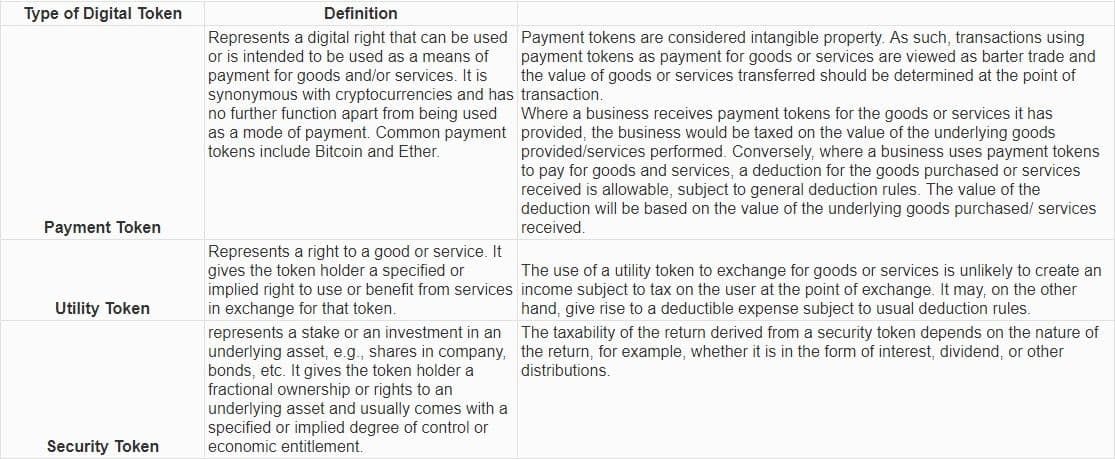
Generally, where crypto assets are exchanged for fiat currency or converted from one form of payment token to another, the resulting gains are taxable under Singapore tax laws if gains can be characterised as revenue and not gains in capital. To determine whether such gain is taxable, therefore, certain factors are to be considered, including the nature of the subject matter involved, the length of ownership, the frequency of transactions, etc.

To this end, the Inland Revenue Authority of Singapore (“IRAS”), Singapore’s tax authority, has issued regulations on the tax treatment of transactions involving crypto assets.

Transactions involving digital tokens

Screenshot_1.jpgScreenshot_1.jpg

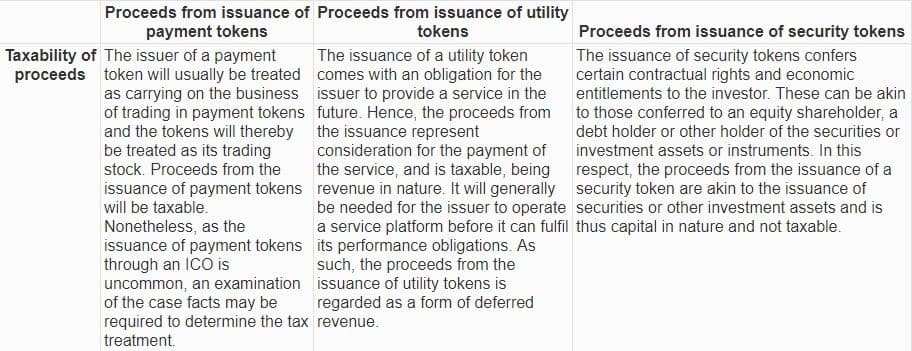
ICO

An ICO refers to the first issue of a digital token to the general public. It is commonly used as a method to raise funds for new projects. The taxability of ICOs depends on the rights and functions of the tokens issued to the investors. The proceeds from the issuance of payment tokens may be taxable depending on its specific facts and circumstances while the proceeds from the issuance of utility tokens will generally be regarded as deferred revenue. Proceeds from the issuance of security token is akin to proceeds from the issuance of securities or other investment assets or instruments, which means they are capital in nature and therefore not taxable.

Screenshot_2.jpgScreenshot_2.jpg

Are crypto assets recognized as a type of property in your jurisdiction?

Yes, crypto assets, particularly cryptocurrency, were recognised in the case of CLM v CLN as property that were thereby subject to enforcement action. See Question 2. Crypto assets were also recognised as a type of intangible property in the case of B2C2 Ltd v Quione Pte Ltd [2019] SGHC(I) 03 where the Singapore International Commercial Court held that cryptocurrencies have fundamental characteristics of intangible property as being an identifiable thing of value. The characterization of crypto assets as property is also supported by its tax treatment by IRAS where its proceeds are taxable if it is classified as revenue in nature. See Question 7.

How does your jurisdiction deal with the application of property laws to intangible assets and conflicts of laws with other jurisdictions

Where multiple jurisdictions are involved in dealings involving crypto assets, the proper choice of law under Singapore conflicts law would be determined based on the following approach:

  1. If the parties to the contract have expressly selected a law to govern the contract, that will be the proper law (the subjective proper law), unless the choice was not made in good faith. The exception is narrowly construed. The choice of an unconnected law is not in itself objectionable.
  2. If the parties have not made any express selection, the court may infer a choice from the contract and the surrounding circumstances at the time of the making of the contract.
  3. If the court cannot find any choice by the parties, then the proper law is the law of the country or system of law with the closest and most real connection with the transaction and the parties i.e., the objective proper law.

can smart contracts transferring ownership on a crypto asset be treated as legally binding in your jurisdiction?

Yes, smart contracts such those transferring crypto assets can be considered as legally binding under Singapore laws. General common law contract principles apply; that is, with respect to the smart contract, there must have been an intention to create legal relations, there was an exchange of consideration, and material terms of the smart contract must be clear and sufficiently complete. To this end, Singapore law has already recognized the validity of electronic or online contracts under the Electronic Transactions Act (2010) (“ETA”).

Is it possible to take security over a crypto asset in your jurisdiction? If so, please provide a brief overview.

Security interests over intangible property is recognized under Singapore law. Given that crypto assets are considered intangible property, such security interests can be perfected and enforced under existing Singapore law. How such security interest will be enforced in fact in Singapore remains generally untested.

Does inheritance tax relief exist in your jurisdiction for situations where fluctuations in the market result in a beneficiary paying disproportionate tax?

Singapore has not imposed inheritance taxes from 15 February 2008.

Is there any forthcoming or proposed legislation in your jurisdiction relating to crypto assets?

MAS Guidelines on Provision of Digital Payment Token Services to the Public In January 2022, MAS expressed its stance on cryptocurrencies by launching a guideline on provision of DPT services to the public (the “MAS guidelines on DPTs”)1 that curbs marketing of cryptocurrencies.

The new guideline mandates that DPTs must not be promoted to the general public, and this includes any forms of advertisement or promotional materials in public areas, websites, broadcast, print media and physical automated teller machines (“ATM”). DPT service providers are therefore limited to promoting their services on their own website, mobile applications, or their official social media accounts but this is also subject to the requirement that such advertising must not trivialise the risks of trading in DPTs in a manner that is inconsistent with or contradictory to risk disclosures under the PSA. As a result, Daenerys & Co, the biggest cryptocurrency ATM operator in Singapore has shut down all its ATMs to comply with the new guidelines.2 The definition of DPT services will also be expanded with the amendment to the PSA and empower MAS to impose measures on DPT service providers. The broadened scope would therefore include the transfer of DPTs, provision of custodian wallet services for DPTs, and facilitating the exchange of DPTs without possession of monies or DPTs by the DPT service provider.

Although the MAS guidelines on DPTs does not regulate payment token derivatives ("PTD”) unless they are offered by an “approved exchange”3 under the SFA, it provides that DPT service providers should not promote PTDs as an alternative to trading in DPTs and should not mislead the public that the PTDs are less risky than DPTs. PTDs are derivatives contracts that reference DPTs as underlying assets which include contracts-for-differences and futures contracts.

The Financial Services and Markets Bill

On 5 April 2022, the Singapore Parliament passed the Financial Services and Markets Bill4 (the “FSM Bill”). This new Bill will require Virtual Asset Service Providers (“VASP”) established in Singapore to be licensed by the MAS, even if the VASP services are provided overseas. In addition, these VASPs will be subject to Singapore laws on anti-money laundering and the financing of terrorism. The bill also specifically grants the MAS greater powers to issue prohibition orders against individuals deemed unfit in performing key roles, activities, and functions in the cryptocurrency industry.

The FSM Bill empowers the MAS to issue prohibition orders and enhances the regulation of VASPs by implementing AML/CFT standards and licensing requirements. Licensed VASPs are also required to have a meaningful presence in Singapore and be under the supervisory oversight of MAS. Furthermore, the FSM Bill introduced technology risk management (“TRM”) requirements where a breach of TRM requirements would entail penalties for the relevant person or entity. For each breach of a TRM requirement, the maximum penalty is raised to S$ 1 million and in the case of multiple breaches, the penalty will be lumped to be over S$1 million. Finally, the FSM Bill also provides for statutory protection from liability for mediators, adjudicators, and employees of operator of approved dispute resolution schemes if they acted with reasonable care and in good faith.

  1. The Monetary Authority of Singapore, “Guidelines on Provision of Digital Payment Token Services to the Public”, 17 January 2022.
  2. Tang See Kit, “Crypto curbs: Industry players say ad ban not the only way to protect retail investors in Singapore”, 20 January 2022, Channel News Asia.
  3. Section 8(1)(a) read with section 9(1)(a), Securities and Futures Act (2001).
  4. See: https://sso.agc.gov.sg/Bills-Supp/4-2022/Published/20220214?DocDate=20220214

Is there a supranatorial view on crypto assets in your region and if so, what is it?

There is no supranational view on crypto assets in the region where Singapore is located. Notably, countries in the ASEAN region have demonstrated significant divergence in fundamental policies relating to crypto assets, and in the resulting implementing laws and regulations. Singapore has adopted a more moderate and accommodating regulatory approach to crypto assets versus its neighbours, which have outlawed the use of crypto assets entirely.

Is there anything else that you think is unusual or different about how your jurisdiction treats crypto assets or dealings in crypto assets?

Singapore has and will likely continue to adopt a pragmatic approach to the regulation of crypto assets, considering its growing use in commerce and business especially in relation to crypto assets that are used for payment or currency substitutes. However, it is expected that the Singapore government will take a more active regulatory role where crypto assets are sold or marketed as investment instruments, where harm to unsophisticated investors and to the general public is more likely.

Disclaimer: This guide contains summaries of general principles of law. It is not a substitute for specific legal advice and should not be relied upon in relation to the application of the law or subject matter covered.