
TerraLex Cross-Border Guide to Cannabis Guide

Welcome to the Terralex cross-border cannabis guide

This guide offers a cross-border analysis on the current state of regulation for various cannabis products, including medical marijuana, recreational marijuana, hemp, and CBD, as well as details on any applicable financial incentives, special tax considerations, and investment limitations.

How to Use: You can use the tools below to create bespoke reports for the jurisdiction(s) and topic(s) covered. Click into single jurisdiction for one location or use the compare tool to compare multiple jurisdictions. Select the jurisdictions and topics of interest to create your unique report. You also have the option to print or download using the ellipsis button in the top right corner.

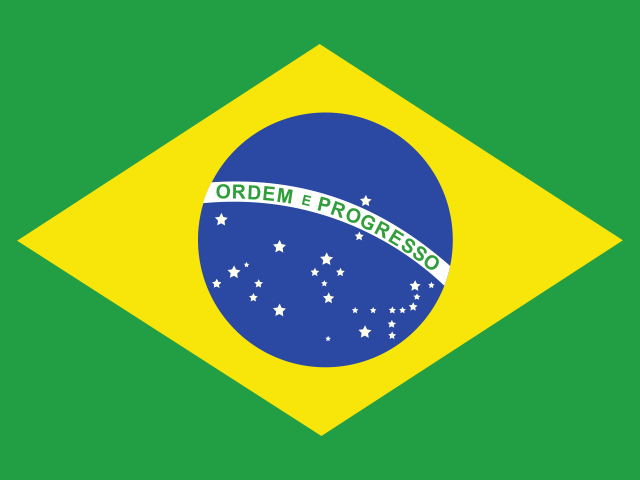
Brazil Cannabis Guide Guide

Date posted:
01/12/2022
Last update:
04/04/2025

Is medical marijuana legal in this jurisdiction?

Law Nº 11,343/2006 prohibits drugs, throughout the Brazilian territory, as well as the planting, cultivation, harvesting and exploitation of vegetables and substrates from which drugs can be extracted or produced, except in the case of legal or regulatory authorization, as well as what establishes the United Nations Vienna Convention on Psychotropic Substances, of 1971, regarding plants for strictly ritualistic-religious use.

However, the Brazilian National Agency of Sanitary Vigilance (ANVISA) has authorized the exceptional importation of cannabidiol-based medicines and other cannabinoids for personal use since 2015. ANVISA's resolutions are limited to regulating the prescription, exposure and import of ready-made products or the manufacture in Brazil of compounds based on imported raw materials.

ANVISA issued the Resolution Nº 17/2015 that "defines the criteria and procedures for the importation, on an exceptional basis, of a product based on Cannabidiol in association with other cannabinoids, by individuals, for their own use, upon prescription of a legally qualified professional, for health treatment". In addition, ANVISA's Resolution Nº 327/2019 "provides for the procedures for granting Sanitary Authorization for the manufacture and importation, as well as establishing requirements for the commercialization, prescription, dispensing, monitoring and inspection of cannabis products for medicinal purposes".

Lastly, on November 13, 2024, the Superior Court of Justice authorized the importation of seeds and the cultivation of industrial hemp for medicinal, pharmaceutical, and industrial purposes. The court determined that the low THC concentration of industrial hemp does not classify the substance as narcotic, thereby removing restrictions on its cultivation. Consequently, the ANVISA has been granted a period to establish appropriate regulations.

1.1. Please describe the licensing requirements to grow (fees, process, restrictions, etc.).

Until the present day, Brazilian law prohibits the planting, cultivation, harvesting and exploitation of vegetables and substrates from which drugs can be extracted or produced, except in the case of legal or regulatory authorization.

1.2. Please describe the licensing requirements to manufacture products.

According to the ANVISA's Resolution Nº 327/2019, the company interested in manufacturing, importing or/and commercializing cannabis-based products, must have a sanitary authorization, granted by ANVISA itself. In order to obtain said authorization, the company must file an application to ANVISA fulfilling the necessary requirements and presenting the applicable documentation, among which we mention: (i) summary of the technical-scientific rationale for the formulation of the product; (ii) packaging and labeling layout; (iii) raw materials and finished product quality control report; (iv) cannabis-based products use monitoring plan; and (v) list of batches manufactured or imported during the year, intended exclusively for commercialization in the Brazilian market.

1.3. Please describe the licensing requirements to distribute products to other re-sellers.

There are no specific licensing requirements to distribute cannabis-based products to other re-sellers. ANVISA's Resolution Nº 327/2019 establishes that all rules regarding distribution of regular medicines applied to the distribution of cannabis-based products.

1.4. Please describe the licensing requirements to distribute products directly to consumers.

There are no specific licensing requirements to distribute cannabis-based products to consumers. ANVISA's Resolution Nº 327/2019 establishes that all rules regarding distribution of regular medicines applied to the distribution of cannabis-based products.

1.5. Please describe the limitations on purchasing and marketing.

Cannabis products can be prescribed when other therapeutic options available in the Brazilian market are exhausted. Purchases can only be made by patients presenting a valid medical prescription of a professional legally qualified for health treatment. Any advertisement cannabis-based products are prohibited (ANVISA's Resolution Nº 327/2019, article 12).

1.6. Please describe the regulations around potency, formulation, and combining with other products.

ANVISA's Resolution Nº 327/2019 establishes that "Cannabis products containing exclusively plant derivatives or phytopharmaceuticals of Cannabis sativa as actives must have predominantly cannabidiol (CBD) and no more than 0.2% tetrahydrocannabinol (THC)" (Article 4º). Cannabis products may only contain THC content above 0.2% if they are intended for palliative care exclusively for patients without other therapeutic alternatives and in irreversible or terminal clinical situations. In addition, "Isolated substances of synthetic or semi-synthetic origin cannot be added to Cannabis products, with the exception of those with an excipient function" (Article 10, § 2º)

1.7. Are there municipal, regional, provincial, or other licenses required?

Regarding cannabis-based products, regulations are solely issued by ANVISA, which has federal jurisdiction.

1.8. What industries have been most impacted by the legalization of medical marijuana and how?

Both the agribusiness and the pharmaceutical industry would be the most affected sectors should the legalization of cannabis medical use reached greater proportions, due to cultivating seeds in an appropriate soil, increasing research as well as filing and exploring patents and cultivars.

Is recreational marijuana legal in your jurisdiction?

According to Law Nº 11,343/2006, "Whoever acquires, keeps, has in deposit, transports or brings with him, for personal consumption, drugs without authorization or in disagreement with legal or regulatory determination will be subjected to the following penalties: (i) warning about the effects of drugs; (ii) provision of services to the community; (iii) educational measure of attendance at an educational program or course" (Article 28).

However, on June 26, 2024, the Supreme Federal Court concluded a nine-year deliberation by decriminalizing the possession of cannabis for recreational use. The ruling establishes that individuals found with up to 40 grams of cannabis, or cultivating up to six female cannabis plants, will no longer face criminal charges. Instead, such conduct is deemed an administrative infraction, subject to measures like warnings about the negative effects of drug use and mandatory participation in educational programs.

2.1. Please describe the licensing requirements to grow (fees, process, restrictions, etc.).

N/A

2.2. Please describe the licensing requirements to manufacture products.

N/A

2.3. Please describe the licensing requirements to distribute products to other re-sellers.

N/A

2.4. Please describe the licensing requirements to distribute products directly to consumers.

N/A

2.5. Please describe the limitations on purchasing and marketing.

N/A

2.6. Please describe the regulations around potency, formulation, and combining with other products.

N/A

2.7. Are there municipal, regional, provincial, or other licenses required?

N/A

2.8. What industries have been most impacted by the legalization of recreational marijuana and how?

N/A

Is hemp legal in your jurisdiction?

No, hemp is not legal in the Brazilian jurisdiction. However, it’s worth mentioning that, on November 13, 2024, the Superior Court of Justice authorized the importation of seeds and the cultivation of industrial hemp for medicinal, pharmaceutical, and industrial purposes. The court determined that the low THC concentration of industrial hemp does not classify the substance as narcotic, thereby removing restrictions on its cultivation. Consequently, the ANVISA has been granted a period to establish appropriate regulations.

3.1. Please describe the licensing requirements to grow (fees, process, restrictions, etc.).

N/A

3.2. Please describe the licensing requirements to manufacture products.

N/A

3.3. Please describe the licensing requirements to distribute products to other re-sellers.

N/A

3.4. Please describe the licensing requirements to distribute products directly to consumers.

N/A

3.5. Please describe the limitations on purchasing and marketing.

N/A

3.6. Please describe the regulations around potency, formulation, and combining with other products.

N/A

3.7. Are there municipal, regional, provincial, or other licenses required?

N/A

3.8. What industries have been most impacted by the legalization of hemp and how?

N/A

Is CBD legal in your jurisdiction?

See items 3 and 4 above.

4.1. Please describe the licensing requirements to grow (fees, process, restrictions, etc.).

N/A

4.2. Please describe the licensing requirements to manufacture products.

N/A

4.3. Please describe the licensing requirements to distribute products to other re-sellers.

N/A

4.4. Please describe the licensing requirements to distribute products directly to consumers.

N/A

4.5. Please describe the limitations on purchasing and marketing.

N/A

4.6. Please describe the regulations around potency, formulation, and combining with other products.

N/A

4.7. Are there municipal, regional, provincial, or other licenses required?

N/A

4.8. What industries have been most impacted by the legalization of hemp and how?

N/A

What is the agency (are the agencies) and relevant laws in this jurisdiction responsible for regulating cannabis and cannabis-related products?

ANVISA is the agency responsible for regulating cannabis and cannabis-related products in Brazil.

Are there any special financial incentives to spur cannabis industry development?

In Brazil there are sparse local initiatives in some states (e.g., Rio Grande do Norte, Paraiba, Pernambuco, etc.) that deal with the encouragement of scientific research and cultivation of cannabis by authorized associations and distribution of herb-based medicines in the Unified Health System (SUS).

However, it is worth mentioning that none of these initiatives has a federal scope. In addition, in cases where there was some progress (e.g., Federal District), the law was sanctioned but not regulated, preventing effective initiatives from taking place.

Are there special tax considerations related to cannabis commerce, not described above?

There is no special tax related to cannabis commerce in Brazil.

Are there any specific investment limitations related to cannabis commerce, not described above?

There are no specific investment limitations related to cannabis commerce in Brazil.

If any of the above are illegal or highly regulated, what are the prospects for adoption or loosening of restrictions? How would this be accomplished (legislature, regulation, voter initiative, courts, etc.)?

There are several draft bills regarding cannabis under discussion in the Brazilian Congress. The Draft Bill Nº 399/2015 seeks to enable the commercialization of any drugs that contain extracts, substrates, or parts of the plant called Cannabis sativa, or cannabinoid substances, if there is proof of their therapeutic efficacy, duly attested by a medical report for all cases of indication of their use.

Also, recent decisions of certain courts, notably the Superior Court of Justice and the Supreme Federal Court, can contribute to the loosening of restrictions.

What do you consider to be the top recent cannabis developments in this jurisdiction?

The top recent cannabis developments in the Brazilian jurisdiction were: (i) the decision issued by the Supreme Federal Court decriminalizing the possession of 40 grams of cannabis or six female cannabis plants; (ii) the decision issued by the Superior Court of Justice authorizing the importation of seeds and the cultivation of industrial hemp for medicinal, pharmaceutical, and industrial purposes, granting a period to ANVISA establish the appropriate regulations; and (iii) the advancement of the Proposed Constitutional Amendment (PEC) 45/2023, which seeks to define drug possession as a criminal offense within the text of the Brazilian Federal Constitution. The PEC 45/2023, currently awaiting approval in the Chamber of Deputies, represents a direct legislative reaction to the judiciary’s stance, reaffirming that Congress must analyze the possibility of the decriminalization of drugs.

What do you consider will be the top cannabis developments in the next year in this jurisdiction?

Considering the current scenario, the main developments in the next year may be the increase of the discussion about PEC 45/2023 and the establishment of regulations by ANVISA regarding the importation of seeds and the cultivation of industrial hemp for medicinal, pharmaceutical, and industrial purposes.

Please share any other issues relevant to doing business in the cannabis industry in this jurisdiction.

Despite being regulated only in relation to the pharmaceutical sector, the cannabis industry in Brazil is constantly growing and presents positive predictions for the coming years. Currently, the Brazilian market moves around 853 million reais per year, having shown a 22% increase in the use of medical cannabis from 2023 to 2024.

Disclaimer: This guide contains summaries of general principles of law. It is not a substitute for specific legal advice and should not be relied upon in relation to the application of the law or subject matter covered.